USAID
Fiscal Year 2009 Chief FOIA Officer’s Report
The U.S.
2009 · 4 pages
Sign in to readA free account is required to download.
Abstract
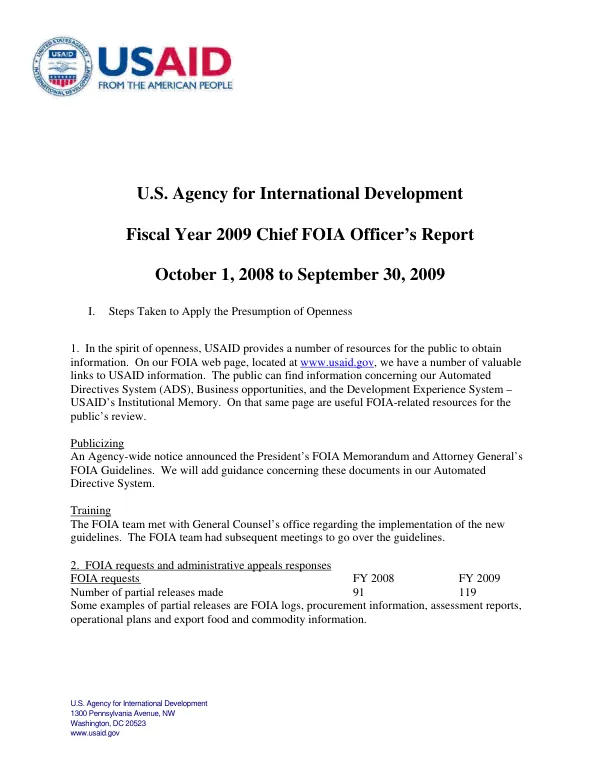
Agency for International Development (USAID) implemented various steps to apply the presumption of openness in Fiscal Year 2009. The agency provided public access to information through its FOIA web page, which included links to valuable resources such as the Automated Directives System (ADS), Business opportunities, and the Development Experience System. Additionally, the agency publicized the President's FOIA Memorandum and Attorney General's FOIA Guidelines through an agency-wide notice. USAID also took steps to ensure an effective system for responding to FOIA requests. The agency identified key roles played by various personnel, including FOIA Contact Officers (FCO), Action Officers, the General Counsel's Office, the Declassification Team, and IT Support. These personnel worked together to direct requests, search for documents, and provide recommendations on release and/or withholding of information. To increase proactive disclosures, USAID proactively posted information online, including frequently requested documents such as credit card holders' information, Iraq reconstruction information, and audit reports regarding antiterrorism vetting procedures. The agency also utilized technology to process requests and prepare its Annual FOIA Report. In terms of reducing backlogs and improving timeliness in responding to requests, USAID reported a significant increase in backlogged requests from 116 in FY 2008 to 233 in FY 2009. The agency attributed this increase to a small staff and the receipt of complex requests that required additional reviews and consultations. To address this issue, USAID put in a request to hire additional staff to help reduce the backlog and improve timeliness in responding to requests. USAID's FOIA team met with the General Counsel's office to discuss the implementation of new guidelines, and the team had subsequent meetings to review the guidelines. The agency also utilized technology to track requests electronically and to process requests. However, the agency reported an increase in the age of pending requests, with the oldest pending request dating back 1956 days and the oldest pending appeal dating back 875 days.