DAI
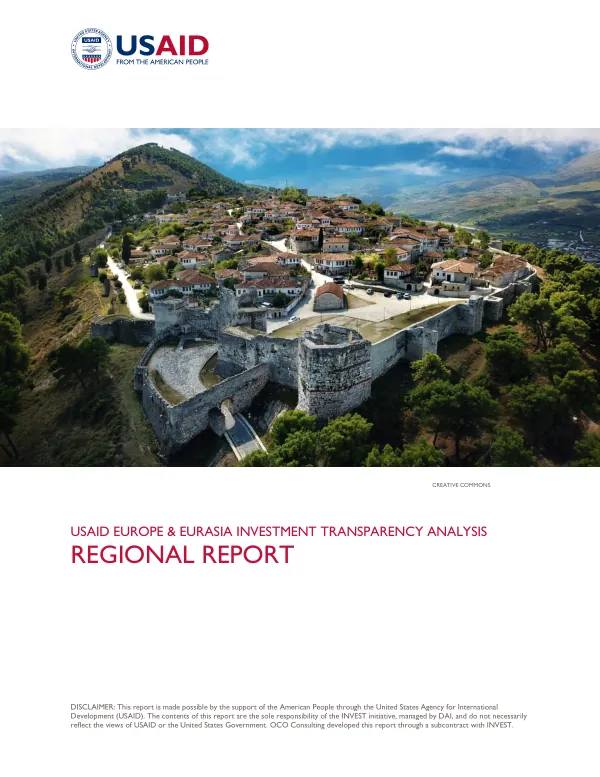
USAID Europe and Eurasia Investment Transparency Analysis: Regional Report
The USAID Europe & Eurasia Investment Transparency Analysis Regional Report aims to improve understanding of the state of investment transparency in eleven countries in Europe and Eurasia.
72 pages
Sign in to readA free account is required to download.
Abstract
The report covers five research topics or pillars: Investment Environment, National Public Procurement Systems, Digitalization of Investment Transactions, State-owned Enterprises (SOEs), and Ultimate Beneficial Owner (UBO) Review. The study includes desk research, stakeholder interviews, and the results of a scoring model to gather information. The report highlights the importance of an open, well-regulated investment environment in encouraging continual development and mitigating the downside risks from foreign influence. A poorly regulated investment environment can attract low-quality investors that thrive on chaos and weak governance, delivering negative side effects that can undermine economic development benefits. Sensitive sectors and projects vary across countries, but critical sectors most likely to be sensitive for national security include technological innovation and data, energy, natural resources, finance, and infrastructure. The report emphasizes the need for clear information and transparent processes to assess risks associated with foreign investment. Poor regulation repels leading global investors, including many from the United States and other highly developed markets. These investors tend to be hesitant to invest in economies where the rules are unclear and subject to manipulation. Attracting global business leaders is essential to absorbing good practices in economic governance, transparency, labor standards, and environmental impact. The study covers eleven countries in Europe and Eurasia: Albania, Armenia, Azerbaijan, Bosnia and Herzegovina (BiH), Georgia, Kosovo, Moldova, Montenegro, North Macedonia, Serbia, and Ukraine. The report aims to inform the USAID Bureau for Europe and Eurasia (E&E) about the strengths and weaknesses in investment transparency and future country interventions. By boosting transparency, each country can lower its risk profile and better position itself to attract sustained levels of higher-quality foreign investment. The report identifies key strengths and weaknesses for the region, including broad findings that apply across the whole region and more specific findings that cover smaller country groupings. The report also suggests priority areas for improving investment transparency in the region and key areas in which USAID could make a meaningful contribution to facilitate improved investment transparency. In-depth analyses of each country's results and strengths and weaknesses can be found in eleven separate country-level reports. The report highlights the importance of implementing good practices in investment transparency, such as clear information and transparent processes, to attract high-quality foreign investment. The report also emphasizes the need for countries to adopt good governance practices, such as transparency and accountability, to ensure that foreign investment benefits the local economy and society.