USAID DEC
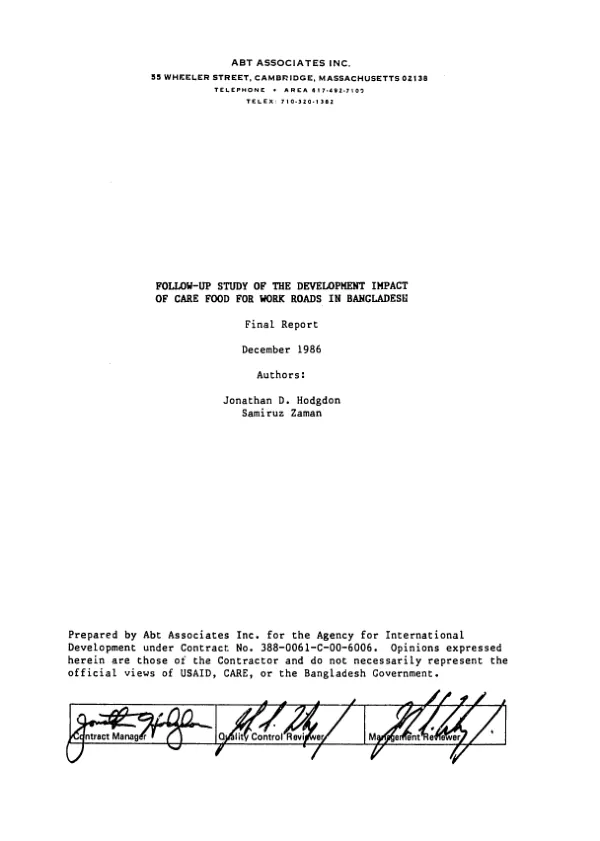
Follow-up study of the development impact of CARE Food for Work roads in Bangladesh : final report
Sign inABT ASSOCIATES, INC.
Follow-up study of the development impact of CARE Food for Work roads in Bangladesh : final report
Evaluates Food for Work (FFW) project implemented by CARE to build and maintain rural roads in Bangladesh.
Hodgdon, Jonathan D.|Zaman, Samiruz · 1986
Sign in to readA free account is required to download.
Abstract
Impact evaluation, follow-up to a 1983 impact evaluation, covers the period 1980-86 and is based on interviews with 683 farmers, businessmen, and others in villages near 17 roads built by the project in 1984 and in 18 comparison sites from the same upazillas visited in 1983. Also included were field inspections of 18 roads built in 1980. The roads built in 1980 and 1984 were in much better condition and more heavily travelled than roads proposed for reconstruction in 1987. Only 12% of the the latter were passable at least halfway by rickshaw, compared with 69% of the 1984 roads and 83% of the 1980 roads. The superior condition of the older FFW roads is attributable to recent maintenance under the new Women's Maintenance Program (WMP). Evaluation data indicate that the project has improved local communications, reduced travel times and transport costs, and increased primary school attendance, commercial activity, local maintenance, access to health care, and use of new farm technologies. There was some evidence that the project helped to increase agricultural production and farmgate prices and to lower input costs for most major crops. On the other hand, there was no evidence of impact on crop mix, primary school absenteeism, road use by local women, or agricultural extension and family planning outreach. Further, FFW roads actually seem to cause a decrease in the use of local health clinics, presumably because of increased access to upazilla hospitals. Roads with the highest development impacts tended to be those: (1) passable by rickshaw; (2) with fewer unbridged gaps; (3) recently maintained; (4) with good or excellent surface conditions; (5) near electricity lines or a bank; and (6) in areas with doash (mixed) soil rather than sandy soil. Of these factors, the key indicator of overall impact for the 1984 roads was whether or not the road was fully passable by cycle rickshaw 2 years after construction. These results are highly consistent with those of the 1983 evaluation, the main exceptions being the new indications of increased local maintenance and higher producer surpluses brought about by road reconstruction, and the failure to confirm positive impacts of the roads on the use of local health and family planning services and of fertilizer and better seeds. Despite the improvements in local maintenance, however, the evaluation team observed many roads with too few bridges and too little maintenance. It recommends that USAID/B and CARE continue to support and expand the Appurtenant Structures Project and continue to encourage the expansion of the WMP and provide support if necessary. (Author abstract, modified)