USAID DEC
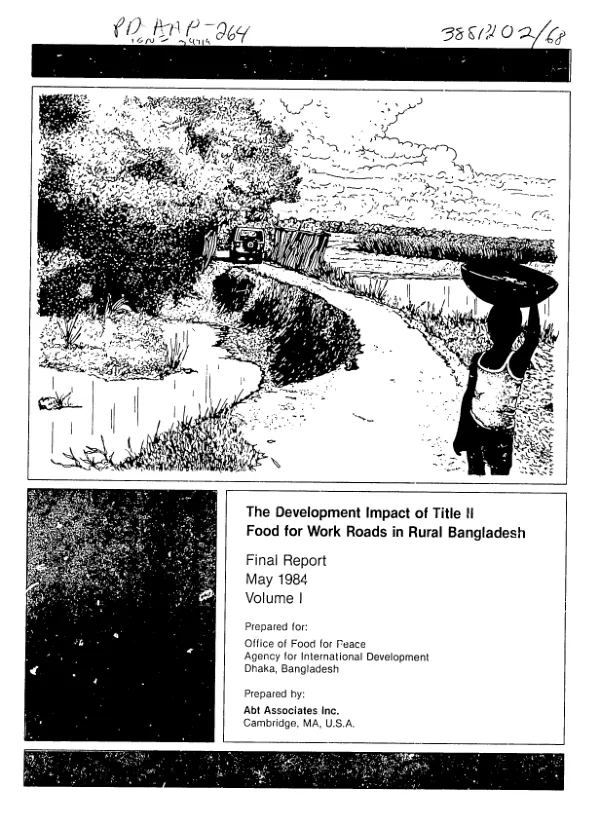
Development impact of Title II (CARE) Food for Work roads in rural Bangladesh : final report
Sign inABT ASSOCIATES, INC.
Development impact of Title II (CARE) Food for Work roads in rural Bangladesh : final report
Evaluates the development impact of a CARE Food for Work (FFW) project to build rural roads and road embankment structures in Bangladesh.
Hodgdon, Jonathan D.|Riordan, James T.|Zaman, Samiruz · 1984
Sign in to readA free account is required to download.
Abstract
Special evaluation covers the period 1975-83 and is based on comparisons between already built and proposed roads and interviews with local leaders and beneficiaries. The project is achieving its goals of upgrading rural infrastructure and stimulating rural economic and social development. FFW roads built in 1980 and 1982 proved to be in much better condition and were more heavily traveled than are those proposed for reconstruction in 1984, although no 4-wheeled motor vehicles were observed on any of the roads; the superior condition of the older FFW roads is largely attributed to more recent maintenance. Positively, FFW roads have: improved local communications; reduced travel time and transport costs to and from the local market; and increased commercial activity, the use of new farm technology, access to health services, use of family planning services, and primary school attendance. Moderate evidence supports further positive impacts: decreased annual flooding near the road; increased use of the road by women; and increased use of health services. Negatively, the roads have mainly benefitted large landholders, thereby widening the already severe gap between rich and poor. There is no hard evidence to support road impact on crop mix and production or farm prices. The roads with the highest estimated development impacts overall tended to be those which were built earlier, had fewer unbridged gaps, were selected on the basis of development-related criteria and were recently maintained (features that should be sought in future projects); and were built near electric lines, in low distress areas, and in areas with doash (mixed) soil rather than sandy soil. Other recommendations are to: expand emphasis on building bridges and culverts; build alternative types of roads in high distress areas having high concentrations of sandy soil and bullock cart traffic; and coordinate site selection with other rural development progams, especially in electrification and family planning.