DEVELOPMENT ALTERNATIVES, INC. (DAI)
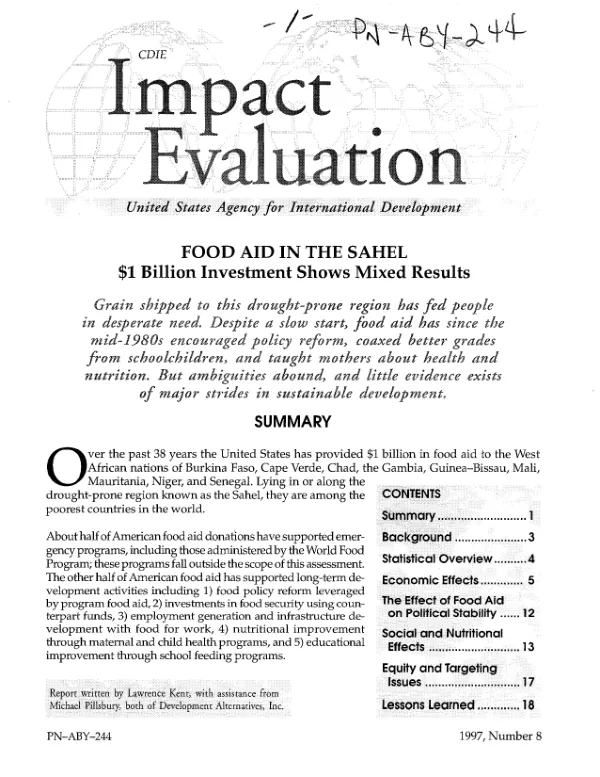
Food aid in the Sahel : $1 billion investment shows mixed results
Assesses the impact of some $500 million in U.S.
Kent, Lawrence|Pillsbury, Michael · 1996
Sign in to readA free account is required to download.
Abstract
food aid provided over the past 38 years to the Sahelian nations of Burkina Faso, Cape Verde, Chad, The Gambia, Guinea-Bissau, Mali, Mauritania, Niger, and Senegal. Results have been mixed. Programs that sought long-term outcomes have had difficulty generating measurable results. Some, such as maternal and child health (MCH) programs, have largely failed to achieve their principal objectives (e.g., nutritional impact on young children). Others, such as school feeding programs, have generated positive and measurable results but present challenges in sustainability. Still others, such as those dealing with policy reform and food for work (FFW), have succeeded in many cases, but the full effects are difficult to measure because of problems of attribution and potentially negative side effects. Specific findings and lessons learned are noted below. (1) Program food aid is a double-edged sword. Recipient governments can use it to facilitate growth-inducing reforms, or they can use it to finance statist policies, support overvalued currencies, and postpone change. In the early 1980s, USAID's efforts were often confounded by this problem, but by the mid-1980s, when conditionalities became directed at market liberalization, food markets had become more efficient. Because many of the policy reform successes in the Sahel were achieved in coordination with other donors, it is inappropriate to attribute the changes solely to USAID. (2) Monetization of program food aid has resulted in significant budget support for recipient governments. Local currency generations have been invested in a wide variety of activities. Some have yielded positive returns (such as tree planting to stabilize dunes), others, negative returns (financing state marketing agencies), and still others, ambiguous returns (strengthening an agricultural marketing board). Ambiguities have also arisen about the ownership and fungibility of counterpart funds, often resulting in disputes on how to program the money, account for it, and report on its uses. (3) Overall, FFW has a good record as a tool for targeting food to the poor during severe droughts in the Sahel. Its record as a tool for longer term development, however, is mixed and poorly documented. In some cases, FFW has served to build useful public works, but in others it has created low-quality infrastructure of limited value. In some cases, it has facilitated community development projects, but in others it has weakened the spirit of self-help necessary for genuine community initiative. To succeed, however, FFW must be well managed and used for carefully designed projects. Moreover, donors must always be vigilant for potential behavior-distorting effects of FFW and take steps to minimize them, particularly in community development projects. (4) MCH programs, most of them managed by Catholic Relief Services, have a long but generally weak record in the Sahel. Evaluators have consistently failed to find a positive nutritional impact from these programs; this could be due either to the actual lack of nutritional impact or to methodological problems. Failure to show measurable results led to the closure of most MCH programs in the Sahel by the late 1980s. The MCH experience did show, however, that children under 2 are generally more likely to benefit nutritionally, and in a measurable way, from targeted feeding than are older children. It also showed that MCH education programs (as distinct from nutrition improvement programs) generally improved mothers' knowledge and practices about health and nutrition. (5) U.S. food aid supported only two school feeding programs in the Sahel, and information is available only on the larger one, carried out in Burkina Faso for over 30 years. Evaluators found evidence that this program had a positive impact on children's nutrition, attendance, and academic achievement. School feeding programs can have measurable, positive effects. But they can go on for perhaps too long a time if implementors neglect to develop an exit strategy or to define a finish line before starting them.
![Sahel water data network and management III program (AGRHYMET project) : [Mid-term] evaluation](https://covers.devme.ai/gen/24748.webp)
![Sahel water data network and management III program (AGRHYMET project) : [Mid-term] evaluation](https://covers.devme.ai/gen/7202.webp)