USAID DEC
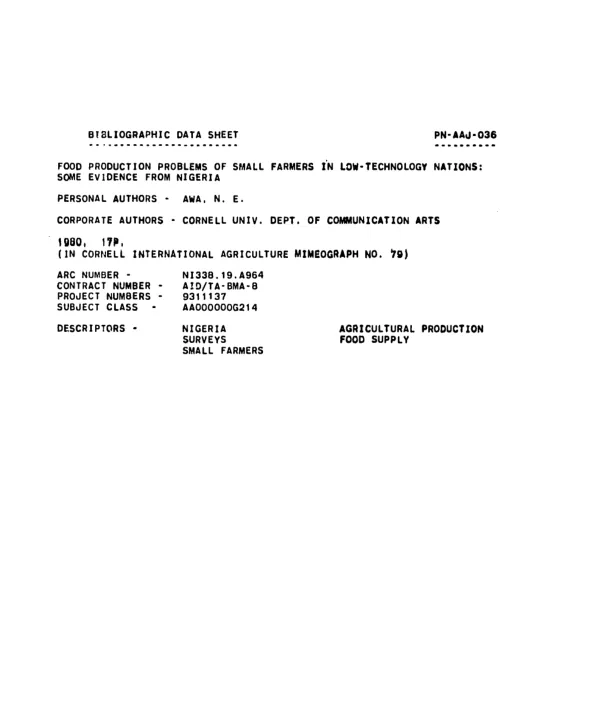
FOOD PRODUCTION PROBLEMS OF SMALL FARMERS IN LOW - TECHNOLOGY NATIONS : SOME EVIDENCE FROM NIGERIA
Sign inCORNELL UNIVERSITY. DEPT. OF COMMUNICATION ARTS
FOOD PRODUCTION PROBLEMS OF SMALL FARMERS IN LOW - TECHNOLOGY NATIONS : SOME EVIDENCE FROM NIGERIA
Small farmers" disinclination to adopt government policies to increase agricultural production should not be viewed as demonstrative of inherent conservatism but rather as a rational response to perceived risks and problems.
AWA, N. E. · 1970
Sign in to readA free account is required to download.
Abstract
Thus concludes this case study on Nigerian farmers" reaction to the Government of Nigeria"s (GON) efforts to promote use of such innovations as fertilizer, pesticide, and new crop varieties. Data gathered from 172 small yam, cassava, rice, and cowpea farmers in Nigeria"s East Central and Southeast States showed that credit non-availability and the lack of agricultural infrastructure were major constraints. Borrowing from friends and family is still practiced for production credit, but there is also a growing class of professional moneylenders who charge high interest rates and enforce rigid contracts. Although State government lending institutions have been established, they are slow, highly selective, graft-ridden (bribes often equal one-third of the loan), and demand detailed information farmers often lack. No money, inadequate knowledge, and high risk were viewed as major constraints to obtaining State credit by 68.6%, 42.4%, and 30.8% of the respondents, respectively -- only 4 farmers (2.3% of the sample) had procured State loans. In the case of infrastructure, lack of basic agricultural support services -- roads, public transport, clean water, electricity, etc. -- reduced farmers" adoptive behavior. This "lack of supply" combined with a "lack of funds" were cited by 55.5% and 51% of the respondents as major disincentives, while risk and non-use by neighbors were deemed critical by only 2.3% and 1%, respectively. This supports previous findings that the GON often raised farmers" expectations but failed to later provide promised inputs (e.g., seeds). Thus, even if farmers were able to obtain credit and grow a larger crop, poor roads and the lack of public transport would result in local sales flooding the market and further depressing already low prices. The author concludes that price supports and ancillary services must be provided to make higher production profitable and permit GON production targets to be met. A 17-item bibliography (1962-77) is appended.
Related documents