USAID DEC
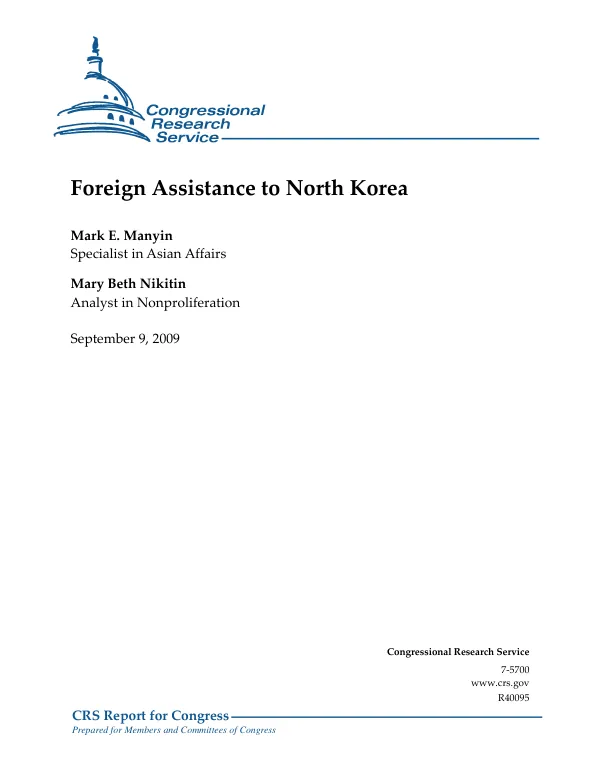
Foreign Assistance to North Korea
The United States has provided North Korea with over $1.2 billion in assistance since 1995, with approximately 60% of the aid allocated for food and 40% for energy assistance.
2009 · 24 pages
Sign in to readA free account is required to download.
Abstract
The majority of the food aid has been provided by China, the United States, and South Korea, with the United States shipping about a third of a planned 500,000 metric ton food aid pledge in 2008 and 2009. However, the program was ceased due to disagreements with the North Korean government. The Obama Administration has stated that it would be willing to provide large-scale aid to North Korea if the country takes steps to irreversibly dismantle its nuclear program. The administration has requested over $150 million for North Korea-related energy and denuclearization assistance in its FY2009 Supplemental Appropriations budget request. However, Congress has denied these requests, instead approving monies for the State Department's general emergency non-proliferation fund that the administration could use in North Korea. North Korea has suffered from chronic, massive food deficits for over a decade, with food aid being essential in filling the gap. The country's food aid has been scrutinized due to the North Korean government's resistance to making economic reforms that would help distribute food more equitably and pay for food imports. Additionally, the government restricts the ability of donors to operate in the country, and some sources have asserted that some of the food assistance is routinely diverted for resale in private markets or other uses. The Six-Party Talks, which involve North Korea, the United States, China, South Korea, Japan, and Russia, have played a significant role in the provision of aid to North Korea. The talks have led to the provision of heavy fuel oil in return for Pyongyang freezing and disabling its plutonium-based nuclear facilities in Yongbyon. The United States and Russia have provided all of the heavy fuel oil they promised under this "Phase Two" of the Six-Party Talks process. However, the talks broke down after North Korea's failed satellite launch on April 5, 2009, which used ballistic missile-related technology, leading to U.N. Security Council condemnation. The United States has also provided technical assistance to North Korea to help in the nuclear disablement process. In 2008, Congress took legislative steps to legally enable the President to give expanded assistance for this purpose. The Obama Administration has stated that it must make a number of decisions regarding the provision of aid to North Korea, including whether to resume food aid, condition assistance on expansive levels of access and monitoring, and pressure South Korea and China to impose similar conditions on their food aid.
Related documents
![Regional technical support project contract no. 410-0004-C-00-3484-00 [i.e. 410-0004-C-00-3483-00] : section I - contractor"s second annual report, fiscal year 1994-1995](https://covers.devme.ai/gen/13294.webp)