NATIONAL AGRICULTURE INSTITUTE
Korean Agricultural Sector Simulation Project
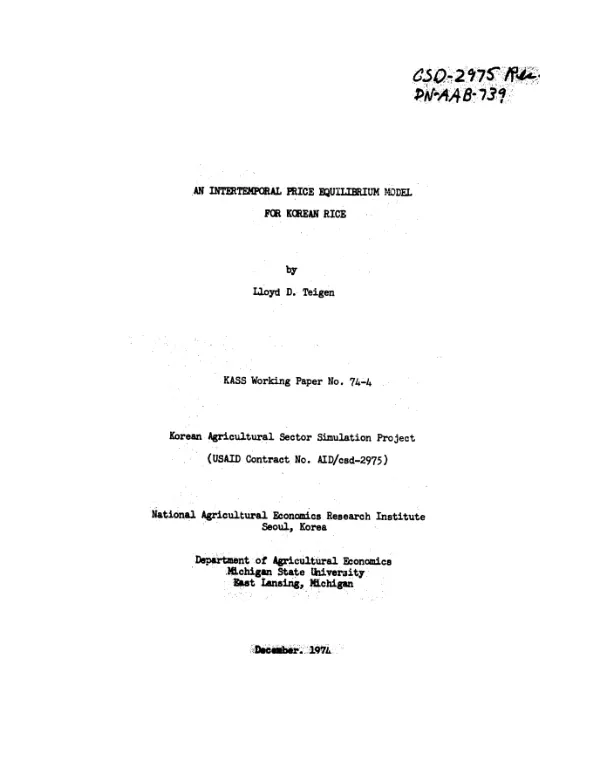
The Korean Agricultural Sector Simulation Project was initiated in 1974 by the National Agricultural Economics Research Institute in collaboration with the Department of Agricultural Economics at Michigan State University.
30 pages
Sign in to readA free account is required to download.
Abstract
The project aimed to develop a comprehensive simulation model for the Korean agricultural sector, focusing on the impact of policy changes on agricultural production, prices, and income. The simulation model, known as the Agricultural Sector Simulation Model (ASSM), was designed to analyze the effects of various policy interventions on the agricultural sector. The model incorporated a detailed representation of the Korean agricultural sector, including crop and livestock production, processing, and marketing. It also accounted for the interactions between the agricultural sector and other sectors of the economy. The project involved a team of researchers from the National Agricultural Economics Research Institute and Michigan State University, led by Lloyd D. Teigen. The team conducted extensive data collection and analysis to develop the ASSM, which was later used to simulate the impact of various policy scenarios on the Korean agricultural sector. The simulation results indicated that policy interventions aimed at increasing agricultural production and income could have significant effects on the sector. For example, increasing the price of rice, a major crop in Korea, could lead to increased production and income for farmers. However, the results also highlighted the potential risks and challenges associated with such policy interventions, including the impact on consumer prices and the potential for market distortions. The Korean Agricultural Sector Simulation Project provided valuable insights into the complexities of the Korean agricultural sector and the potential effects of policy interventions. The project's findings and recommendations were intended to inform policy decisions and contribute to the development of a more sustainable and equitable agricultural sector in Korea. The project's results were presented in a series of reports and working papers, including the KASS Working Paper No. 74-4, which provided a detailed description of the simulation model and its results. The project's findings and recommendations were also disseminated through various channels, including conferences and workshops, to ensure that they reached a wider audience of policymakers, researchers, and stakeholders. The Korean Agricultural Sector Simulation Project was a significant contribution to the field of agricultural economics and policy analysis, and its findings and recommendations continue to be relevant today. The project's use of simulation modeling and its focus on the impact of policy interventions on the agricultural sector have been influential in shaping the field of agricultural economics and policy analysis.