ACDI/VOCA
Forest Incomes for Environmental Sustainability FY19 Quarterly Report
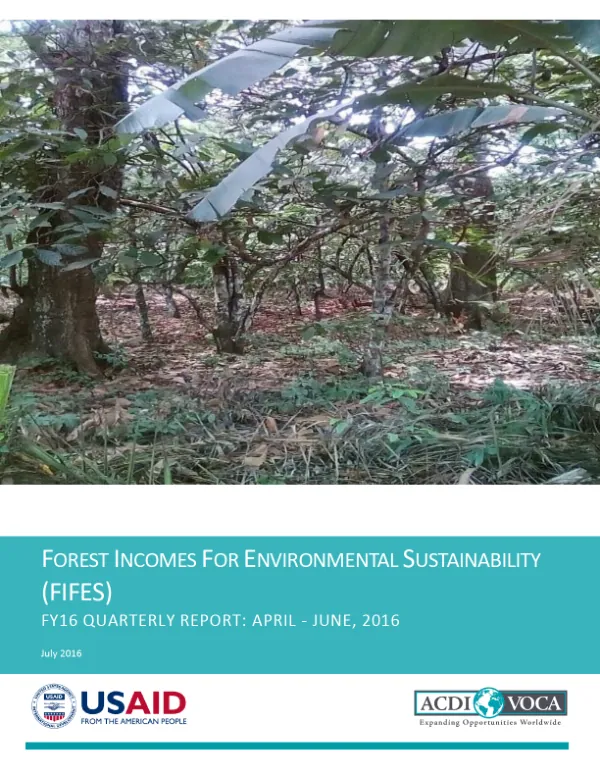
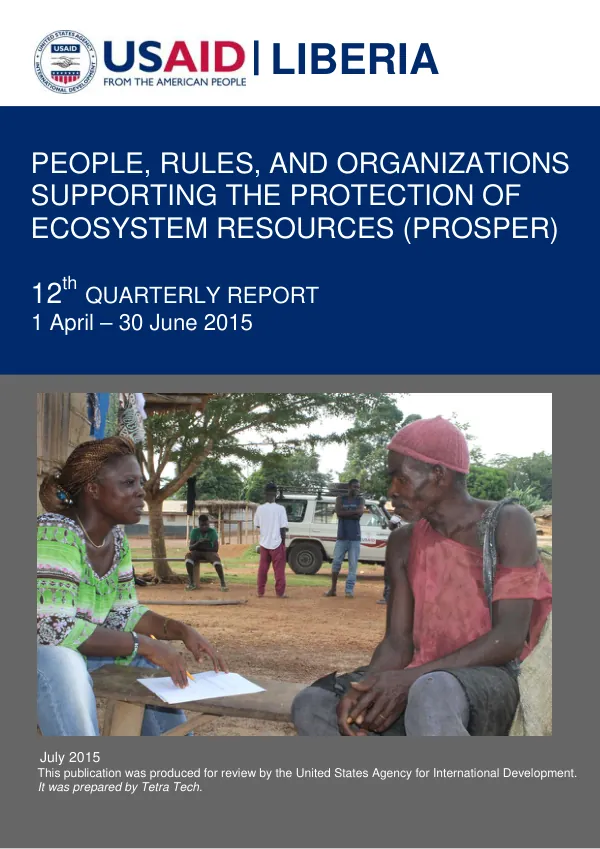
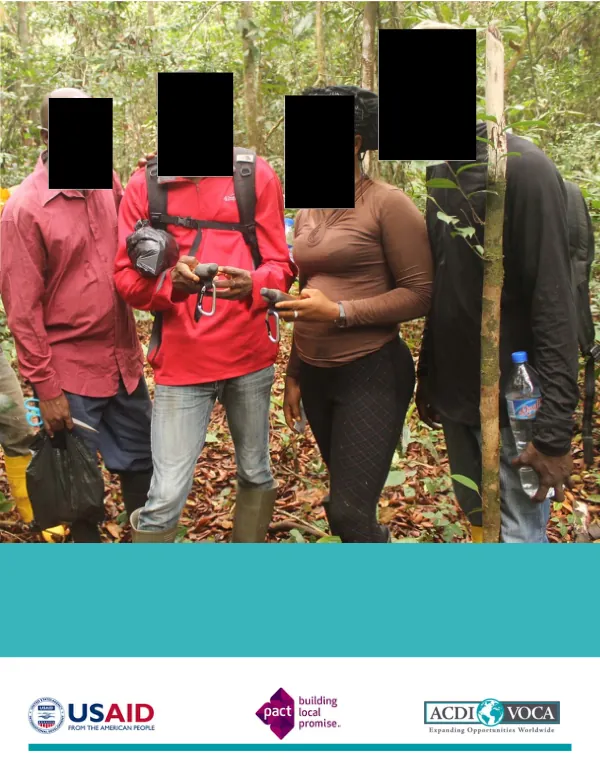
The Forest Incomes for Environmental Sustainability (FIFES) activity is a five-year initiative of the United States Agency for International Development (USAID), implemented by ACDI/VOCA with assistance from Pact and the Center for International Forestry Research (CIFOR).
2019 · 24 pages
Sign in to readA free account is required to download.
Abstract
The FIFES activity is designed to combat deforestation and loss of biodiversity while developing key rural forest-based enterprises that provide sustainable economic opportunities for farmers and forest-dependent communities. The activity contributes to USAID/Liberia's overall sustainable economic growth program to promote equitable and sustainable market-led economic opportunities in Liberia, accompanied by improved natural resource management (NRM). The FIFES activity's goal is the conservation of biodiversity in 11 Community Forests (CFs) in Grand Bassa and Nimba counties. To reach this goal, FIFES staff work with local, regional, and national stakeholders to achieve two main objectives: the creation of well-developed rural forest-based enterprises, which provide sustainable economic opportunities for farmers and forest-dependent communities while combating deforestation and biodiversity loss, and the enhanced capacity of Government of Liberia (GoL) institutions and rural communities to sustainably manage and benefit from CF and buffer zone natural resources. These objectives are reflected in the following three FIFES activity components: 1) Sustainable forest-based enterprises developed and strengthened, 2) Community forest management improved, and 3) Cross-cutting themes: gender, youth, and public outreach. The FIFES theory of change states that if key rural forest-based enterprises provide sustainable increased economic opportunities for farmers and forest-based communities, and the technical and management capacity of GoL institutions and communities that are responsible for the management of CFs are enhanced, then deforestation and biodiversity loss will be reduced. The activity's implementation progress is monitored through a set of indicators, including the number of direct and indirect beneficiaries reached, the number of households reached, and the number of individuals trained in sustainable natural resource management and/or biodiversity conservation. In Quarter II of FY19, the FIFES activity achieved several key results, including the development of two new forest-based enterprises to support program-assisted value chains, and the provision of Business Development Services (BDS) to 181 farmers. Additionally, 43 individuals received training in sustainable natural resource management and/or biodiversity conservation, and 4 Memorandums of Understanding (MOUs) were signed between community forest management bodies and Enterprise Groups. The activity also made progress in improving the enabling environment for agroforest-based business enterprises, with 4 laws, policies, or regulations addressing biodiversity conservation and/or other environmental themes officially proposed, adopted, or implemented as a result of USG assistance. The FIFES activity's results are expected to contribute to the conservation of biodiversity in 11 Community Forests in Grand Bassa and Nimba counties, and to the development of sustainable forest-based enterprises that provide economic opportunities for farmers and forest-dependent communities. The activity's implementation progress will continue to be monitored through a set of indicators, and the results will be evaluated at the end of the five-year period to assess the activity's overall impact.