U.S. DEPT. OF AGRICULTURE. FOREST SERVICE
Forestry activities and deforestation problems in developing countries
To what extent have forestry activities alleviated deforestation problems in developing countries?
Zerbe, John I.; Whitemore, Jacob L. · 1980
Sign in to readA free account is required to download.
Abstract
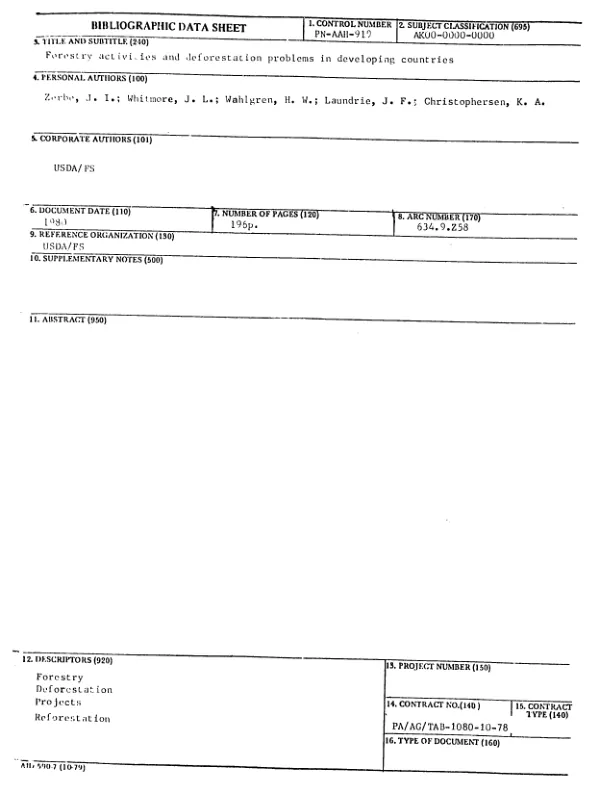
To answer this question, an AID-sponsored 5-man team visited 17 developing countries, interviewed personnel from dozens of donor agencies, and reviewed forestry literature emanating from these countries and agencies. Their findings are presented in this overview report. An inventory of current forestry projects revealed a dominance of industrial efforts -- that is, the establishment of capital-intensive pulpmill or sawmill complexes rather than the management of on-the-ground forestry stands. The second largest activity was reforestation/afforestation. Still fewer donors were involved in conservation activities. The authors conclude that forestry-related problems in developing countries are far worse than ongoing A.I.D. programs indicate. The authors note that forestry projects are often imposed on local residents totally from outside their communities and as a result fail to gain local cooperation. If these projects are to succeed, the local political structure must be involved and local political leaders made to feel that some of their needs are being met by that involvement. Overall, the authors recommend a balance between long-term environmental/forestry goals and immediate energy/food production needs. More coordination is needed among the various international donors and the developing country governments. A.I.D. and other international donors should cease their studies and take action. Sufficient knowledge already exists for sound programs. The authors point out that A.I.D. hiring practices are highly centralized and bureaucratic; more forestry personnel should be hired. In addition, Mission directors should be given authority to hire on the spot. A bibliography on forestry in the developing world (199 entries, 1947-80) is provided. Fifty-eight of the titles are in Spanish.