USAID. BUR. FOR POLICY AND PROGRAM COORDINATION. CENTER FOR DEVELOPMENT INFORMATION AND EVALUATION (CDIE)
Forestry and the environment : Costa Rica case study
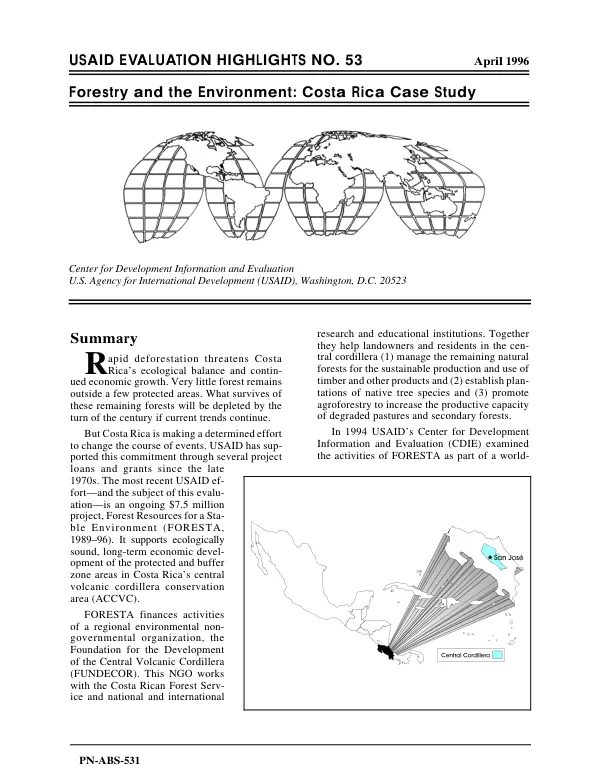
FORESTA (Forest Resources for a Stable Environment), USAID"s most recent effort to stem rapid deforestation in Costa Rica, supports ecologically sound, long-term economic development of protected and buffer zone areas in the country"s central volcanic cordillera conservation area (ACCVC).
Church, Phillip E. · 1996
Sign in to readA free account is required to download.
Abstract
Implementation is headed by the Foundation for the Development of the Central Volcanic Cordillera (FUNDECOR). FORESTA has helped to develop FUNDECOR as a strong, though not yet financially independent, institution capable of applying appropriate technology to management of forest and land resources in the ACCVC. In its first three years, the project under FUNDECOR had already brought 11% of the ACCVC"s 77,000 ha of privately owned forest under more sustainable management and promoted private sector reforestation with native species on about 1,000 ha; both activities have increased landowners" incomes. Additionally, by acting as an intermediary buyer of seed and seedlings and as a contractor for tree-planting and forest-management services, FUNDECOR has generated new forestry investment and employment for a significant number of both men and women. Progress can be attributed to (1) creative approaches to forest management, (2) a political and social framework conducive to cooperative problemsolving between public and nongovernmental organizations, (3) the availability of new forest management and native-species plantation technologies, and (4) strong USAID management. Modest government subsidies for natural forest management and reforestation have contributed to project success, although FORESTA is also developing contractual arrangements with owners of natural forests that do not depend on public funding over the long run. Project efforts are reaching a broad spectrum of socioeconomic groups (although larger landowners dominate) and have increased efficiency in reforestation and natural forest management. The project"s economic viability depends on whether the native tree species used to reforest the ACCVC are biophysically sustainable in the long run; evidence to date is promising, but inconclusive. Already, however, reforestation with native tree species has begun to spread beyond the ACCVC. Two key lessons have emerged. (1) Contracting for services can be an effective means of transferring knowledge, raising awareness, and changing the behavior of natural resource users. (2) Long-term project assistance is required when attempting to establish new NGOs with broad responsibilities for cooperating with other NGOs, community groups, government agencies, and research and educational institutions to manage forest resources.