USAID. MISSION TO PHILIPPINES
Natural resources management program
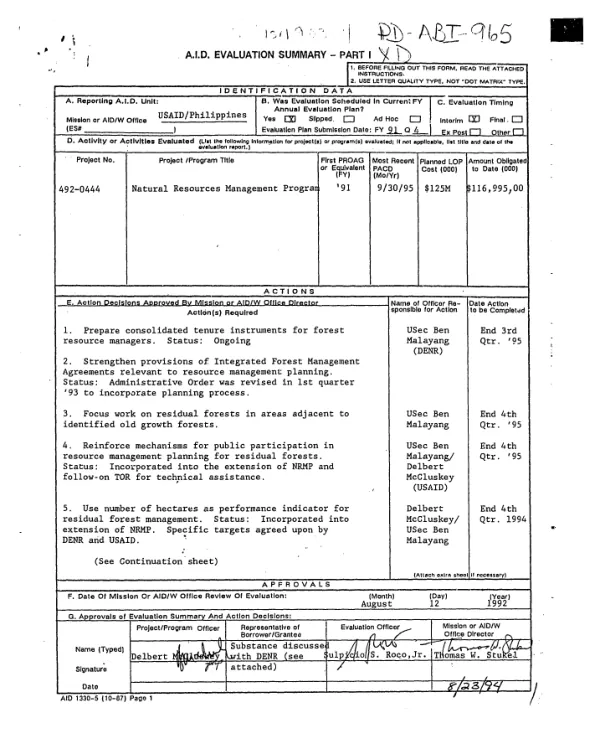
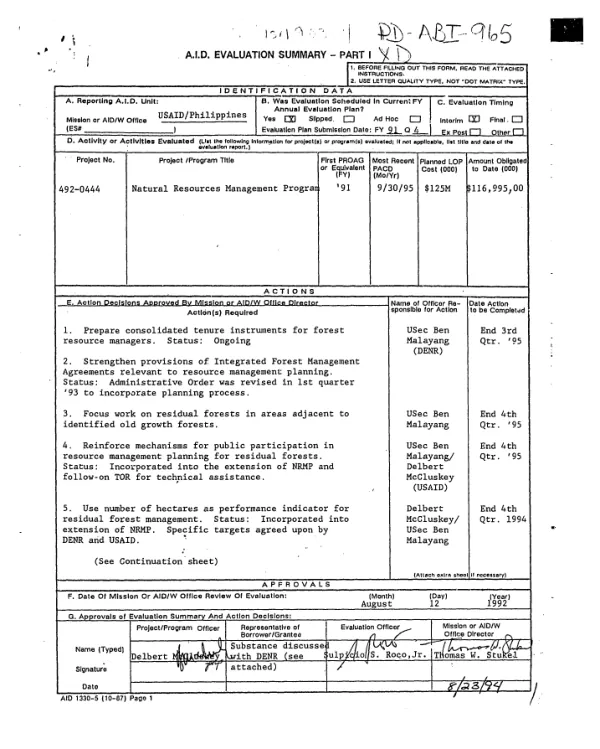
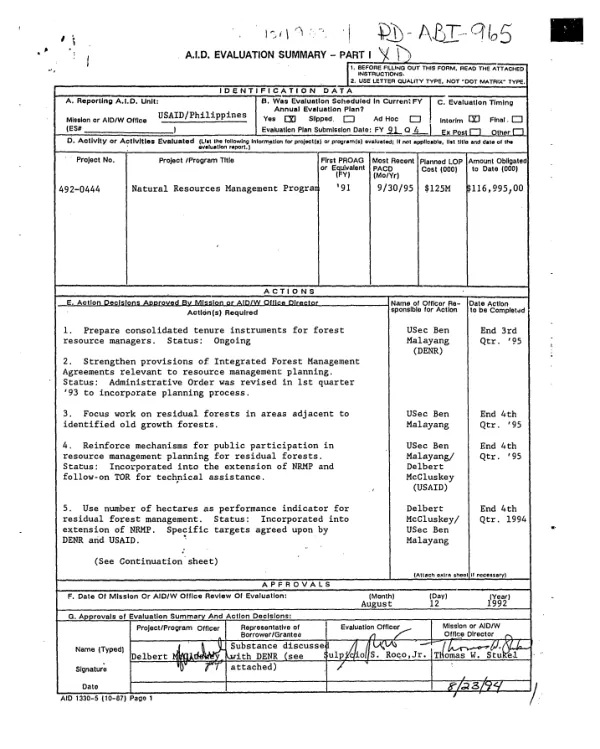
Summarizes attached interim evaluation ((XD-ABI-965-A) of a program to promote economically and ecologically sustainable forest resource management in the Philippines.
1994
Sign in to readA free account is required to download.
Abstract
The evaluation covered the period 1991-9/92. The program has helped the Department of Environment and Natural Resources"s (DENR) to accelerate the process of policy formulation and has provided important support to DENR in its successful efforts to obtain higher priority for environmental management. Specifically, the program has helped the DENR to: (1) issue new forms of land tenure agreements for both industry and community-based resource management; (2) raise charges on forest products, thereby increasing government revenues from forest products seven and a half times; (3) use aerial photography to map old-growth forests; (4) pursue a land-based management approach to residual forest management, focusing on data collection and compilation; (5) make a promising start in initiating community-based forest management activities; and (6) make impressive progress towards establishing the Foundation for the Philippine Environment, which promises to be a sustainable product of the program. On the negative side, little action has been taken to amend regulations that restrict exit/entry of firms to and from forest products industries, and the technology development and transfer (TDT) component has encountered major implementation problems due to unworkable institutional arrangements. The privatization component has failed to stimulate increased investment in the forest products industry, even though the GOP has sold almost 50% of its asset-producing forest products. Problem areas have resulted from organizational arrangements for implementation (TDT), poor contractor performance (Development Alternatives, Inc. for IEC), and unanticipated difficulty and time requirements (residual forest management planning component). The program suffers from lack of coordination of its technical/field assistance activities, suggesting a lack of strategic focus. With one exception, the program is directed towards important policy areas, although most of these are more complicated than originally thought and will require substantially more work than originally anticipated. The exception is privatization, which should be eliminated, since there is no evidence that the sale of GOP forestry assets will contribute to increased competition and investment in the sector.
Related documents