ABT ASSOCIATES, INC.
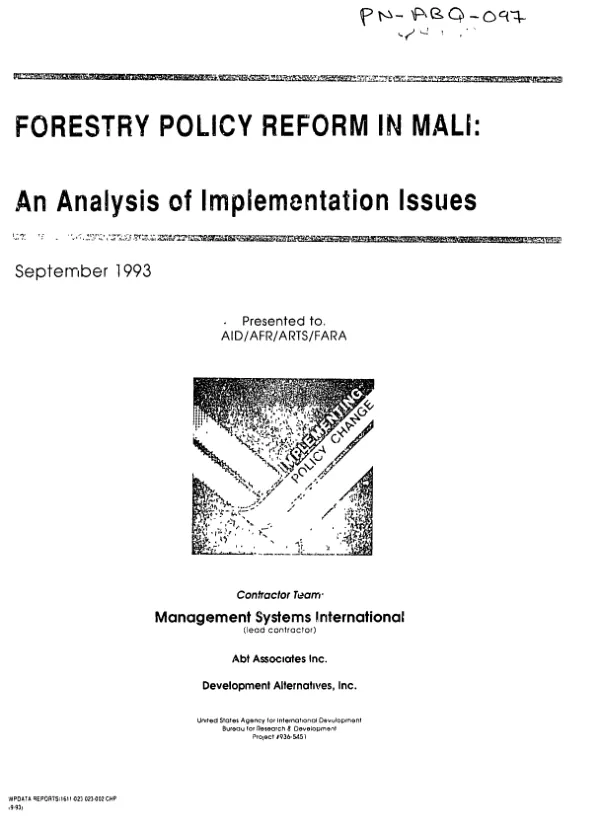
Forestry policy reform in Mali : an analysis of implementation issues
Like many countries in the Sahel, Mali is revising its forestry code to facilitate natural resource management at the local level.
Brinkerhoff, Derick W.; Gage, James D. · 1993
Sign in to readA free account is required to download.
Abstract
Issues involved in implementing the new code, which is expected to be formally adopted in the near future, are analyzed in this report. Section II discusses the evolution of Mali"s forestry code from the 1935 decree which vested authority of natural resources in the hands of the state to the groundswell of support in 1991 for local self-management. Section III examines the forthcoming code using a model that associates six conditions with successful policy implementation, namely, the extent to which the policy and/or its statutes: (1) contain clear and consistent objectives, or criteria for resolving goal conflicts; (2) accurately identify key factors and linkages affecting policy outcomes, including specification of target groups and incentives; (3) are structured to maximize the probability of compliance by implementing agents and target groups; (4) are supported by leaders and senior managers having strong strategic management and political skills; (5) are supported by constituency groups and stakeholders; and (6) are implemented within stable socioeconomic and political environments. Although Mali"s experience with forestry policy shows some problems in meeting these six conditions, a concluding section is cautiously optimistic. The political environment seems propitious, but institutional weaknesses and the lack of an incentive structure may dilute or even derail implementation in the near term, while long-term prospects are clouded by overarching socioeconomic and environmental factors. Faced with these problems, Mali"s forestry policy reformers need to adopt a strategic perspective on managing policy change. Includes bibliography.
Related documents