USAID DEC
Formulario para la Evaluación Rápida de Daños en Vivienda
The Ministerio de Vivienda y Asentamientos Humanos has developed a Formulario para la Evaluación Rápida de Daños en Vivienda to assess damage to residential properties.
5 pages
Sign in to readA free account is required to download.
Abstract
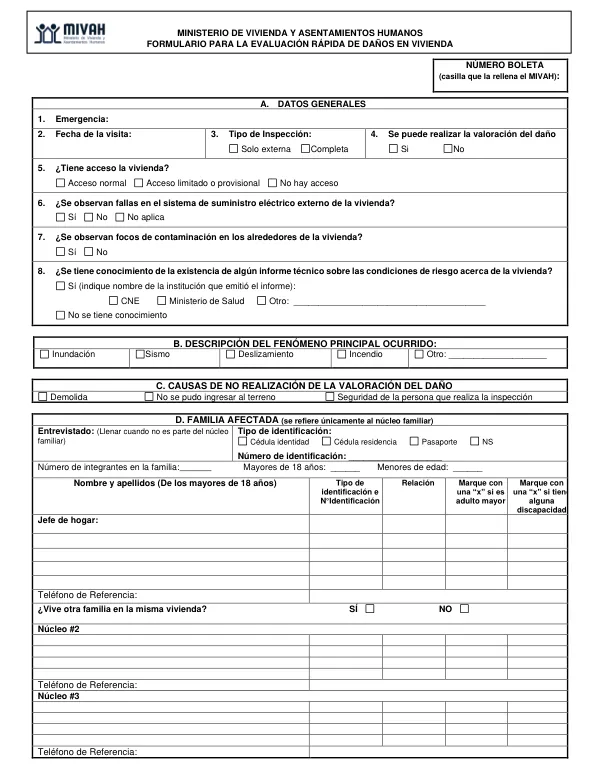
The form is divided into several sections, including A. DATOS GENERALES, B. DESCRIPCIÓN DEL FENÓMENO PRINCIPAL OCURRIDO, C. CAUSAS DE NO REALIZACIÓN DE LA VALORACIÓN DEL DAÑO, D. FAMILIA AFECTADA, E. DATOS DE LA PROPIEDAD, F. LOCALIZACIÓN, G. DATOS DE LA VIVIENDA, H. TIPO DE DAÑO, and I. CLASIFICACIÓN DE DAÑOS EN LA VIVIENDA. The form begins with a series of questions in Section A, including the date of the visit, type of inspection, and whether the property has access. Section B requires a description of the primary phenomenon that occurred, such as an inundation, sismo, or deslizamiento. Section C asks about the causes of not being able to conduct the damage assessment, including demolition, inability to enter the property, or safety concerns. Section D collects information about the affected family, including the number of family members, their ages, and their relationship to the head of household. Section E gathers data about the property, including its topography, tenancy, and age of construction. Section F records the location of the property, including the province, canton, district, and barrio. Section G provides detailed information about the property's construction, including its external and internal walls, roof structure, and flooring. Section H assesses the type of damage, with options ranging from none to grave, and assigns a score based on the severity of the damage. Section I classifies the damage as none, leve, or moderado, based on the total score. The form also includes a section for the entorno, or environment, which assesses potential hazards such as fallen trees, landslides, and water damage. The total score for the entorno is calculated and used to classify the damage as none, leve, or moderado. The form is designed to provide a rapid assessment of damage to residential properties, with the goal of identifying the severity of the damage and determining the necessary course of action. The information collected on the form can be used to inform decisions about repairs, reconstruction, and other interventions to address the damage and ensure the safety and well-being of the affected families. The Ministerio de Vivienda y Asentamientos Humanos has developed this form to standardize the assessment of damage to residential properties, ensuring that all affected families receive a consistent and thorough evaluation of their situation. The form is an essential tool for responding to disasters and emergencies, and its use can help to ensure that affected families receive the support and resources they need to recover and rebuild their lives. The form is used to assess damage to residential properties in various contexts, including natural disasters, accidents, and other emergencies. The information collected on the form is used to inform decisions about repairs, reconstruction, and other interventions to address the damage and ensure the safety and well-being of the affected families. The Ministerio de Vivienda y Asentamientos Humanos has developed guidelines and protocols for using the form, including training for inspectors and other personnel who will be using the form in the field. The form is an essential tool for responding to disasters and emergencies, and its use can help to ensure that affected families receive the support and resources they need to recover and rebuild their lives. The form is designed to be used in a variety of settings, including urban and rural areas, and can be adapted to meet the specific needs of different communities and regions. The information collected on the form can be used to inform decisions about repairs, reconstruction, and other interventions to address the damage and ensure the safety and well-being of the affected families. The Ministerio de Vivienda y Asentamientos Humanos has developed a comprehensive approach to disaster risk reduction and management, which includes the use of the form to assess damage to residential properties. The approach includes a range of activities and interventions, including risk assessment, emergency preparedness and response, and recovery and reconstruction. The form is an essential tool for implementing this approach, and its use can help to ensure that affected families receive the support and resources they need to recover and rebuild their lives. The information collected on the form can be used to inform decisions about repairs, reconstruction, and other interventions to address the damage and ensure the safety and well-being of the affected families.
Related documents