USAID DEC
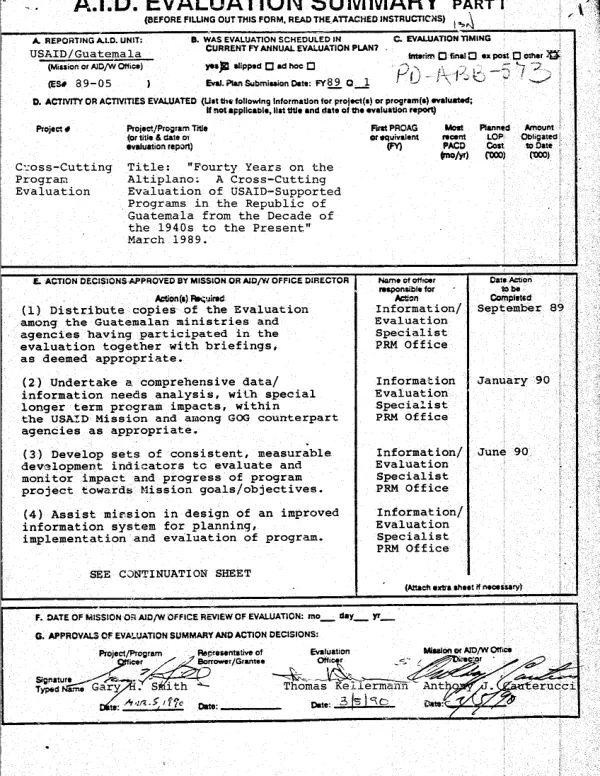
Forty years on the Altiplano : a cross-cutting evaluation of USAID-supported programs in the Republic of Guatemala from the decade of the 1940s to the present
Sign inUSAID. MISSION TO GUATEMALA
Forty years on the Altiplano : a cross-cutting evaluation of USAID-supported programs in the Republic of Guatemala from the decade of the 1940s to the present
Summarizes the cross-cutting evaluation (PN-ABD-830/832) of A.I.D.-supported activities in Guatemala during the 1940"s to the 1980"s.
1990
Sign in to readA free account is required to download.
Abstract
USAID/G core programs (viz., agriculture, education, health, rural infrastructure, and institutional development) have been in-place since the early 1950"s. During the 1960"s, emphasis shifted from urban, institutional strategies to the targeting of rural groups and communities in the indigenous highlands, where it remains today. Since 1975, agricultural programs have focused on crop diversification, small-scale irrigation, soil conservation, rural credit, and rural cooperatives for small farmers. Positive income effects and diffusion of technologies are tangible and widespread, though more attention is needed in the areas of credit and rural marketing. Rural education programs have emphasized basic rural school systems and construction, bilingual education, and nonformal education since the early 1970"s. The bilingual programs have been well-received, and basic and nonformal education projects have successfully addressed problems faced in rural communities. Nevertheless, a rapidly growing population mandates significant expansion of joint A.I.D./Government of Guatemala (GOG) efforts. Rural health programs have been almost exclusively undertaken by A.I.D. Most of these involved the participation of NGO"s. Cadres of local health and family planning promoters are in place, and progress, while slow, has been marked over the past 20 years. Institutional development assistance has been part of most USAID/G projects, and has benefitted GOG ministries and other institutions. However, much remains to be done to promote the decentralization of decisionmaking and budget management reform to make GOG more responsive to needs of target groups in all program areas. Improvements in development information systems would facilitate these efforts. Overall, community-level approaches have been the most successful means of reaching target groups in all USAID/G core programs. Key lessons learned include the following. (1) Recognition of villagers" propensity for group decisionmaking and channelling development assistance through such groups makes acceptance and rapid diffusion of new ideas more likely. "Bottom-up" approaches definitely promote sustainability. (2) Development activities can foster the cumulative build-up of local expertise over the long-term (e.g., 20 years), though this may not be immediately evident in short-term projects. Patience, flexibility, and consistency are critical strategic elements. (3) Controversial or unpopular programs (e.g., family planning) are more acceptable if packaged within a broader program of interventions offered to villagers amid a range of choices. (4) "Supply-increasing" agricultural projects must be accompanied by coordinated activities in the areas of marketing and rural finance. Analysis of likely changes in demand as well as in supply is a key factor in estimating future marketing patterns and impacts upon the consumption of the producers themselves. (5) In giving assistance to public and private sector development institutions, attention must be given to decisionmaking processes, not merely to technical and logistical assistance. (6) Private sector institutions and organizations comprise potentially fruitful and efficient agents for promoting "grassroots" changes. At present, most GOG line ministries are too centralized to function effectively at municipal and village levels. (7) Continued focus upon developmental basics (e.g., appropriate agricultural technologies, rural infrastructure, primary and bilingual education, basic village health care, access roads, and electrification) is politically neutral and provides bases for development of stable, public sector careers. These emphases are also conducive to long-term host country support. (8) The achievement of efficiency in the use of public sector resources for development requires real decentralization of decisionmaking. (9) There is no substitute for close A.I.D. monitoring of real change in areas selected for program focus. Frequent field visits (e.g., once per quarter) should be an integral part of project management. (Author abstract, modified)
Related documents