COUNTER PART INTERNATIONAL
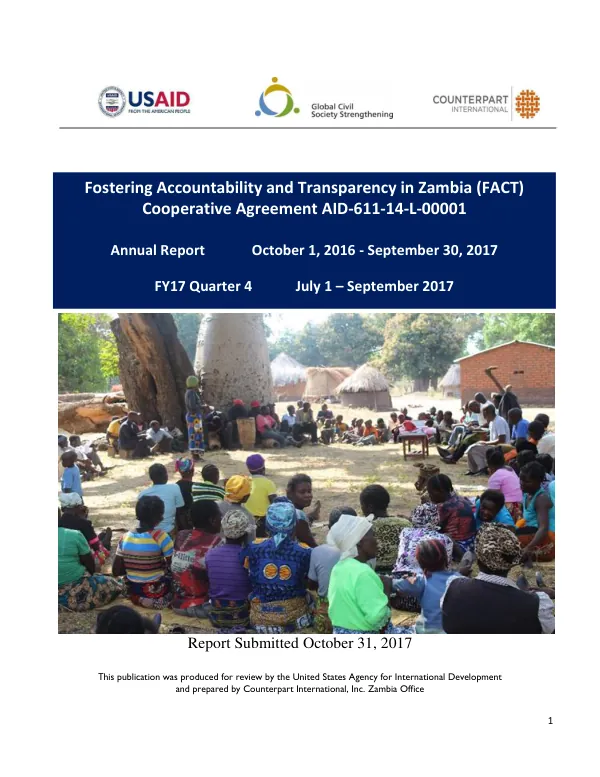
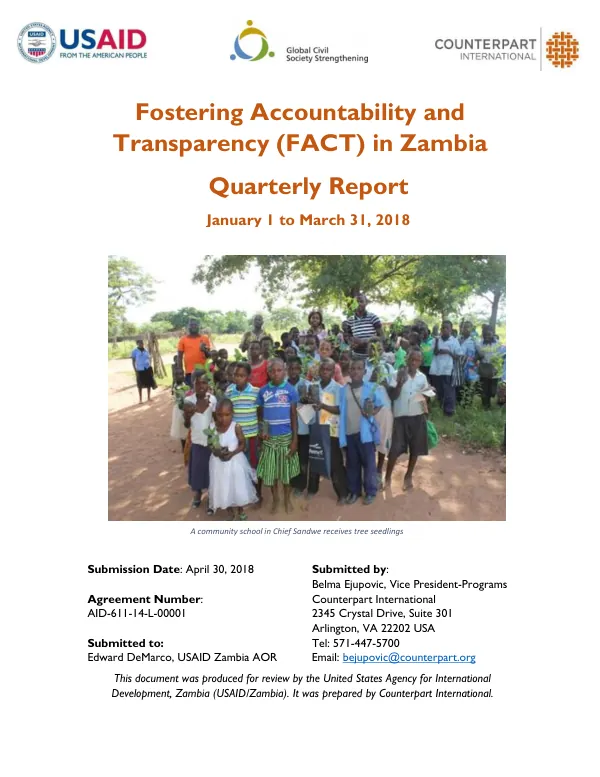
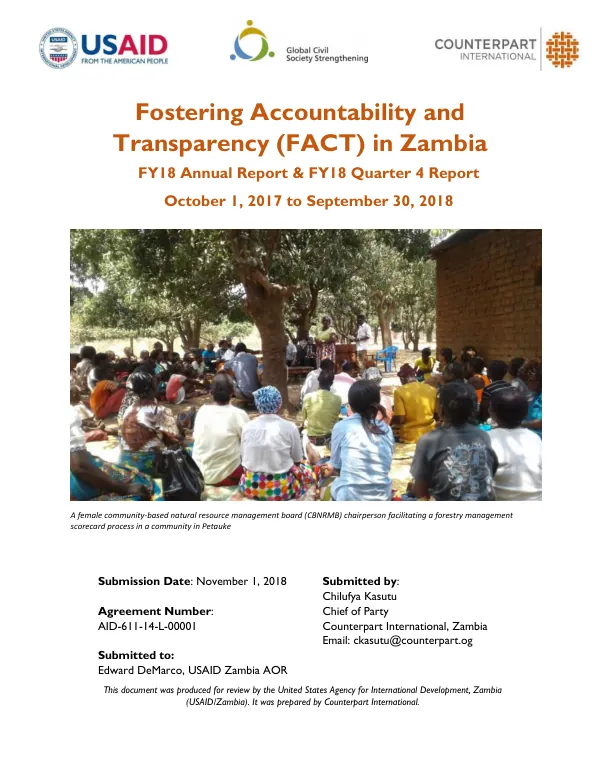
Fostering Accountability and Transparency (FACT) in Zambia
The Fostering Accountability and Transparency (FACT) program in Zambia aims to improve the enabling governance environment by increasing citizen demand for effective, transparent, and accountable service delivery.
2017 · 30 pages
Sign in to readA free account is required to download.
Abstract
The program, funded by the USAID Global Civil Society Leader with Associates Award, began in September 2014 and will conclude in September 2019. The program's goal is to strengthen the capacity of local civil society organizations to enhance delivery and oversight of public service delivery in the education, health, sustainable rural livelihoods, and environment sectors. During the third quarter of FY17, political tensions in Zambia increased due to a growing dispute between the ruling Patriotic Front (PF) and the main opposition party, the United Party for National Development (UPND). The arrest and detention of opposition leader Hakainde Hichilema raised concerns across development partners and Zambian civil society. The two parties were urged to pursue dialogue to resolve their differences. The Seventh National Development Plan was launched by the government in June, which guides Zambia's development and features governance and citizen participation prominently. The Ministry of Health (MoH) and the Ministry of General Education (MoGE) held important consultations with stakeholders during the quarter. The MoH was developing several National Health Strategic Plans, including the Community Health Strategy, which emphasizes the role of Neighborhood Health Committees and other mechanisms in holding service providers to account. The MoGE held its annual Joint Annual Review (JAR), which provided stakeholders, including FACT, to review the Ministry's performance and future plans. FACT local partners increased their activities at the community level during the quarter. The project is now active in 69 wards across eight districts in Eastern and Lusaka Provinces. Local partners continue to establish and strengthen community structures to engage with service providers. Zambia Open Community Schools expanded to an additional six community schools in Chipata district. The work and successes of the Parent Community School Committee (PCSCs) in Chipata were acknowledged during a visit to Chisomo Streamside Community School by U.S. Ambassador Eric Schultz on June 6. The third quarter saw the start of the Participatory Organizational Development Assessments (PODAs) of Counterpart's eight local civil society partners. This is the second round of the PODAs and will provide an indication of progress and changes in FACT partners' organizational development. Counterpart organized two trainings for the eight partners during this quarter: a monitoring and evaluation training in April and a Gender and Social Inclusion training in June. The trainings aimed to build knowledge and skills for gender and social inclusion that could support their integration in partner organizations' programming. A partners' meeting at the end of May provided a platform for FACT partners to share their experiences, challenges, and lessons learned. It was evident that the partners had established strong partnerships with their respective community structures. These partnerships are designed to support programming for community participation, civic education, and interface with service providers, traditional leaders, and government authorities. Many partners have established district-level structures to act as intermediaries between the community level structures and government district-level authorities. The district structures bring together representatives of the community structures to lobby district authorities and to follow up on actions agreed with service providers. A Public Dialogue Forum (PDF) in Lundazi district engaged key stakeholders that the Community Markets for Conservation (COMACO) works with to discuss key conservation and agriculture issues. It created an opportunity for stakeholders to understand their respective roles and responsibilities in promoting conservation and sustainable agriculture practices. The PDF also provided a platform for stakeholders to share their experiences and challenges in implementing conservation and agriculture projects in the district.
Related documents