USAID DEC
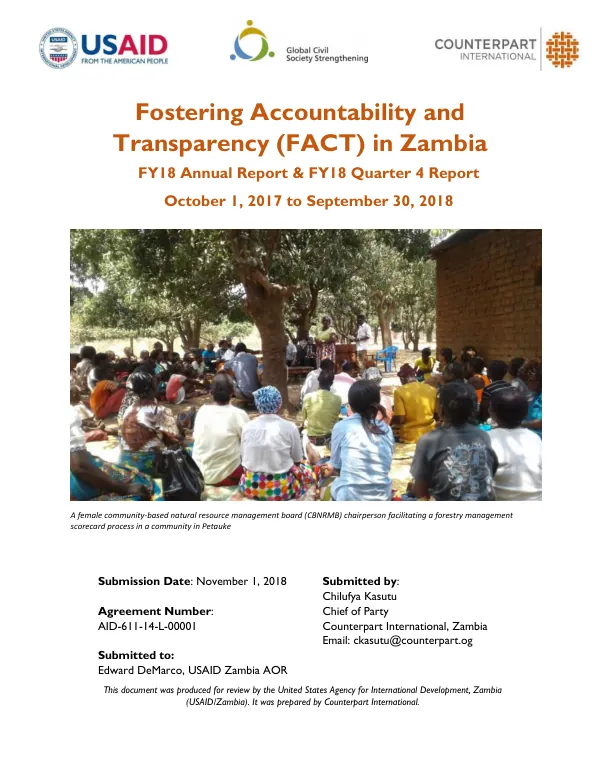
FY18 Annual Report & FY18 Quarter 4 Report: Fostering Accountability and Transparency (FACT) in Zambia
Sign inCOUNTER PART INTERNATIONAL
FY18 Annual Report & FY18 Quarter 4 Report: Fostering Accountability and Transparency (FACT) in Zambia
Fostering Accountability and Transparency (FACT) in Zambia is a program implemented by Counterpart International to improve the enabling governance environment of Zambia by increasing citizen demand for effective, transparent, and accountable service delivery.
2018 · 48 pages
Sign in to readA free account is required to download.
Abstract
The program partners with a range of Civil Society Organizations (CSOs) to strengthen and increase meaningful engagement between Zambian civil society, citizens, and the state to improve the lives of people in the communities where FACT partners operate. The program aims to achieve its goal through two objectives: strengthening the capacity of local CSOs to enhance delivery and oversight of public service delivery in the education, health/HIV, sustainable rural livelihoods, and environment sectors; and improving engagement between citizens and government service providers in the same sectors to improve service delivery. FACT's mid-term review, conducted in June 2018, evaluated the relevance, effectiveness, efficiency, and sustainability of the fostering accountability and transparency model. The review affirmed that the FACT model remains relevant and important for broadening governance in public service delivery. Implementation of FACT's objectives in FY18 focused on strengthening the capacity of local CSOs to enhance delivery and oversight of public service delivery. This involved providing training and technical assistance to CSOs to improve their ability to engage with government and citizens. FACT also worked with CSOs to develop and implement community-based initiatives to improve service delivery in the education, health/HIV, sustainable rural livelihoods, and environment sectors. In addition to strengthening CSO capacity, FACT also focused on improving engagement between citizens and government service providers. This involved facilitating dialogue and collaboration between citizens and government officials to improve service delivery. FACT also worked with CSOs to develop and implement community-based initiatives to improve service delivery in the education, health/HIV, sustainable rural livelihoods, and environment sectors. FACT's work in FY18 also included collaboration and knowledge sharing with other USAID activities and key stakeholders. The program worked closely with other USAID activities to leverage resources and expertise to achieve its objectives. FACT also collaborated with other key stakeholders, including government officials, CSOs, and community leaders, to improve service delivery and increase transparency and accountability. The program's FY18 highlights include the extension of the FACT award for an additional six months and the provision of additional funding for work with the extractive industries. Building on the strong relationships that FACT has established with local, regional, and national stakeholders, the program is well-positioned to continue its work in FY19 and beyond. In terms of results, FACT's mid-term review revealed that the program's interventions have contributed to increased accountability by opening up opportunities for citizens to dialogue and explore the scope of public services across health and HIV, education, and environment and natural resources. Evidence suggests that these important district and community level links are stronger because of FACT interventions and that strong, sustainable partnerships were being created. The study notes that some of the most marginalized communities of women, young women, youth, people with disabilities, and those living with HIV now have an impactful voice in the community for the first time. All of these advances are leading to strengthened transparency and accountability between government and citizens, and – most importantly – improving lives for communities throughout Zambia. Overall, FACT's work in FY18 has demonstrated the program's commitment to improving the enabling governance environment of Zambia and increasing citizen demand for effective, transparent, and accountable service delivery. The program's focus on strengthening CSO capacity and improving engagement between citizens and government service providers has contributed to increased accountability and improved service delivery in the education, health/HIV, sustainable rural livelihoods, and environment sectors.
Related documents