PATHFINDER INTERNATIONAL
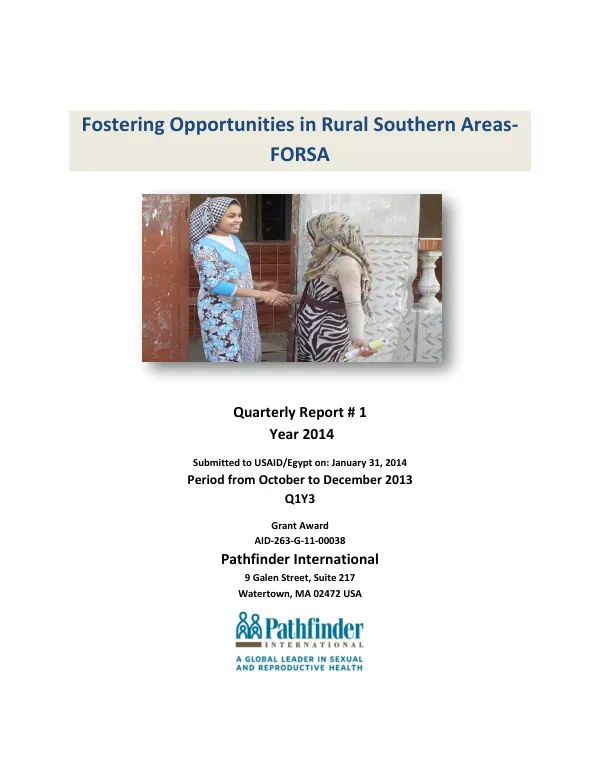
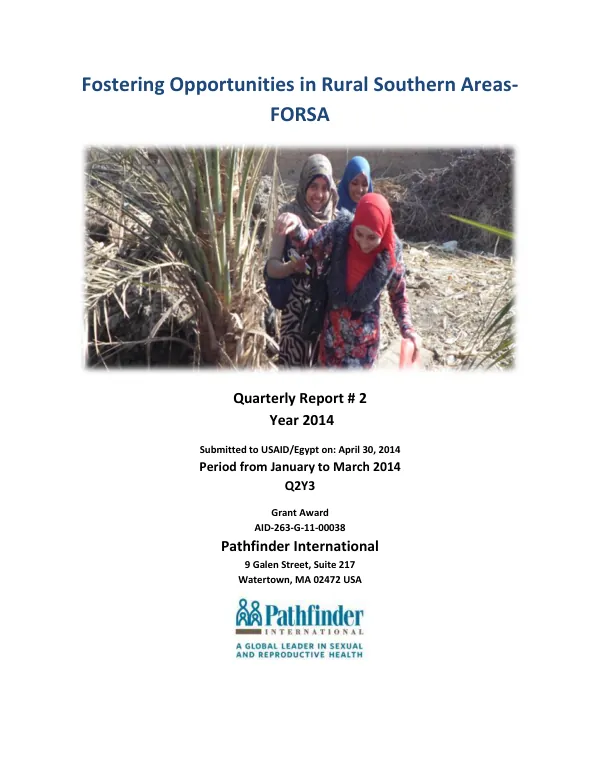
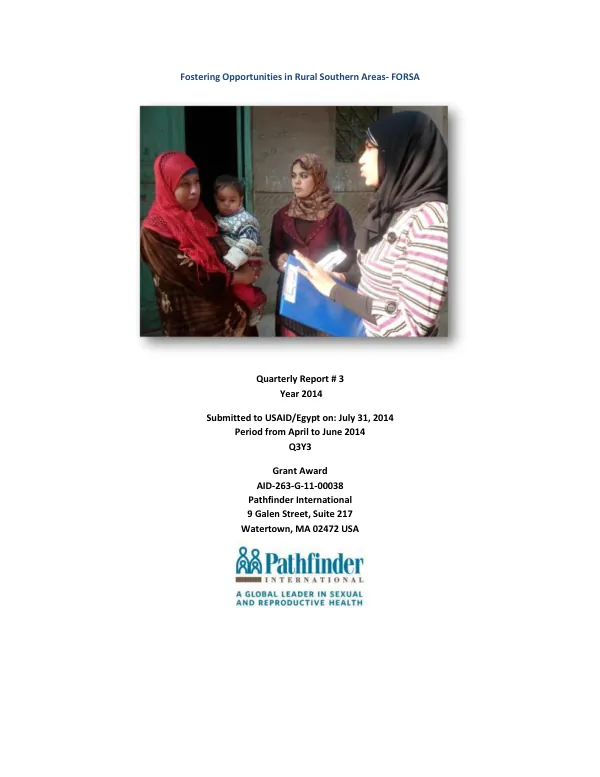
Fostering Opportunities in Rural Southern Areas- FORSA Quarterly Report # 3
The FORSA project, which translates to "opportunity" in Arabic, aims to contribute to poverty reduction among vulnerable youth in rural Upper Egypt.
2014 · 28 pages
Sign in to readA free account is required to download.
Abstract
The project's overall goal is to apply an integrated approach that addresses health and wealth improvements, enhancing social protection. The specific objectives are to provide immediate employment opportunities for 1,400 youth in rural Upper Egypt by establishing a network of community health Outreach Workers to encourage greater access to health delivery services, and to build the capacity of women in rural Upper Egypt and assist them technically and financially to start their own businesses (microenterprises). The project's efforts have culminated in the successful advancement of health and wealth among the target population. All project activities have been successfully implemented in Batch One UNGOs and their partner CDAs target sites, in both Assiut and Souhag Governorates. The Outreach Workers conducted household visits, and all Egyptian Women Speak Out workshops were conducted. In-kind micro-grants were awarded to selected beneficiaries as planned. The post-intervention household survey was successfully conducted, and data collected and analyzed. The project has made significant progress in increasing access to health delivery services. A total of 345 6-days EWSO workshops were conducted across the 75 Project's CDAs, collectively attended by 8,604 target beneficiary women of reproductive age. A total of 5,249 family members attended the 1-day orientation, of which 4,400 were males. The number of workshops conducted and the number of attendees exceeded the targets set for the project. The FORSA project team's decision to increase the number of EWSO workshops participants resulted in 45 additional workshops in Batch 2 and Batch 3 target sites, benefiting 1,104 more women. The project has also made significant progress in building the capacity of women in rural Upper Egypt and assisting them technically and financially to start their own businesses. A total of 2,650 project beneficiaries who attended the EWSO workshops were granted an in-kind microgrant, worth 600 Egyptian Pounds each, to start a micro-enterprise. The micro-grants covered a variety of trades, including but not limited to the handicrafts introduced during the EWSO workshops: liquid soap-making, accessories-making, establishing small beauty shops, and poultry breeding. The number of women receiving micro-grants (2,650) exceeds the target set in the PMP of 2,250 grantees. The project has also demonstrated its ability to adapt to the needs of the community. The FORSA project team's decision to increase the number of EWSO workshops participants was taken after the positive response received from the community members in the project implementation sites, including men, after their participation in the EWSO workshops and the positive effects it had on the lives of women. The project's ability to adapt to the needs of the community has resulted in increased participation and engagement from the target population.