PATHFINDER INTERNATIONAL
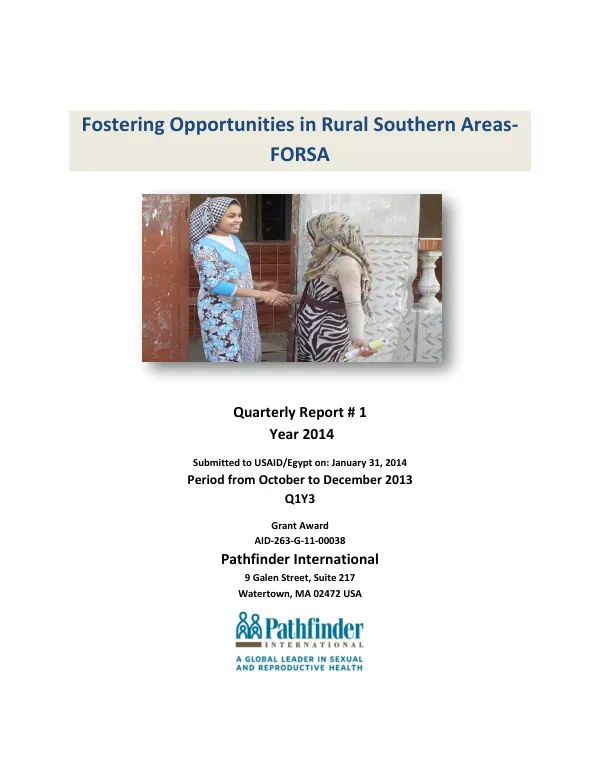
Fostering Opportunities in Rural Southern Areas- FORSA Quarterly Report # 1
The FORSA project, which aims to contribute to poverty reduction among vulnerable youth in rural Upper Egypt, has made significant progress in its first quarter.
2014 · 37 pages
Sign in to readA free account is required to download.
Abstract
The project's overall goal is to provide immediate employment opportunities for 1,400 youth and build the capacity of women in rural Upper Egypt to start their own businesses. To achieve this, the project has established a network of community health outreach workers to encourage greater access to health delivery services. The project has implemented various activities during the quarter, including the transfer of funds to umbrella non-governmental organizations (UNGOs) and the monitoring and controlling of the sub-granting process. A system has been developed to enable UNGOs' staff to monitor the disbursement of transferred funds in reference to the timelines set by the budget plan. This has helped to avoid disbursement delays and smooth the process of subgranting. The project has also focused on quality improvement, particularly in the household visits conducted by the CDAs' Outreach Workers (RRs). More emphasis has been given to the measurement of the quality of the visits rather than just the number of visits. A checklist has been developed to assess the quality of household visits, which features best practices in the process of planning for the visit, interacting with the target woman, and feedback from the woman visited. The project has also made progress in building the capacity of women in rural Upper Egypt. The Egyptian Women Speak Out (EWSO) program has been implemented, which aims to empower women to speak out on their rights and participate in decision-making processes. The program has been conducted in Assiut and Souhag governorates, and more than 1,000 women have participated in the program. The project has also received recognition from senior officials in the implementation governorates, who have endorsed the project's efforts to empower women and improve their socio-economic status. The project has also been featured in the media, highlighting its success in providing employment opportunities for youth and building the capacity of women in rural Upper Egypt. The project's monitoring and evaluation system has been established, which includes the collection of data on project activities and outcomes. The system will enable the project team to track progress and make adjustments as needed to ensure the project's success. The project's budget has been managed effectively, and the project has been able to achieve its objectives despite the challenges posed by the no cost extension plan. The project's success has been attributed to the close collaboration between the project team and the UNGOs' staff, as well as the effective use of resources and the focus on quality improvement. The project's achievements have been recognized by senior officials and the media, and the project continues to make progress in its efforts to empower women and improve their socio-economic status in rural Upper Egypt.