USAID DEC
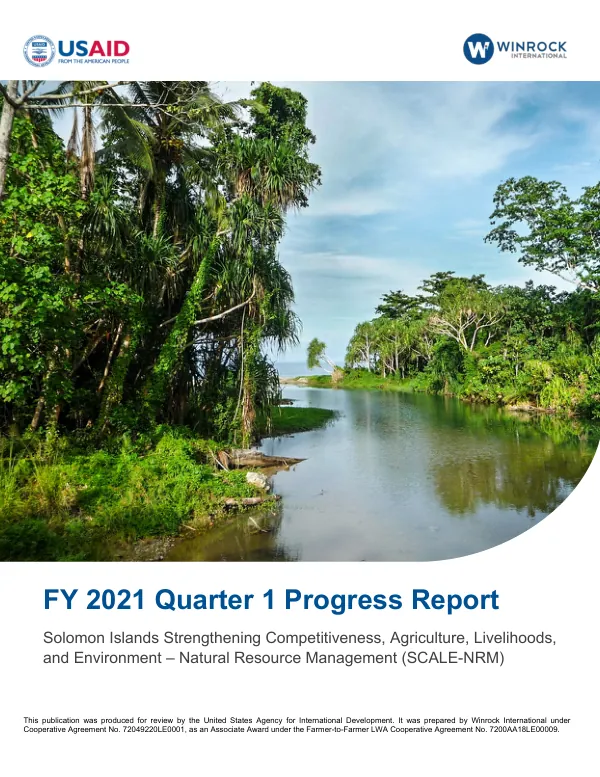
FY 2021 Quarter 3 Progress Report: Solomon Islands Strengthening Competitiveness, Agriculture, Livelihoods, and Environment – Natural Resource Management (SCALE-NRM)
Sign inDAI GLOBAL, LLC
FY 2021 Quarter 3 Progress Report: Solomon Islands Strengthening Competitiveness, Agriculture, Livelihoods, and Environment – Natural Resource Management (SCALE-NRM)
Strengthening Competitiveness, Agriculture, Livelihoods, and Environment – Natural Resource Management (SCALE-NRM) is a program designed to address the underlying causes of forest degradation in Solomon Islands, with a focus on Malaita Province.
2021 · 34 pages
Sign in to readA free account is required to download.
Abstract
The program aims to improve forest governance and ensure sustainable forest management. Implemented by Winrock International, the program has a total budget of $16.5 million, spanning from 2018 to 2025. SCALE-NRM is part of the broader United States Agency for International Development (USAID)-funded SCALE initiative, which aims to improve forest governance, strengthen agri-business and trade, and enhance infrastructure. The overall SCALE program is implemented by five organizations, including Winrock, DAI Global, LLC, Green Powered Technology, Nathan Associates, and Pacific American Fund. During the third quarter of 2021 (April 1 – June 30), SCALE-NRM activities ramped up significantly. A notable event was the Waisisi Land Summit, held in West Are’Are, Malaita, from April 26-28. The summit, attended by 500 traditional leaders from southern Malaita, was chaired by Rose Isukana, a senior tribal leader, and hosted by SCALE-NRM Deputy Chief of Party Dr. Morgan Wairiu. The summit featured awareness activities, and communities showed enthusiasm for the program, generating positive publicity on social media and in traditional media. To ensure the Malaita Provincial Government (MPG) remains informed of project activities, face-to-face briefings have been held every one to two weeks between SCALE-NRM and the Honorable Deputy Premier and the Acting Head of PARU. Zoom calls have also been held every two weeks with the Honorable Premier and the Head of PARU. A briefing and field visit was arranged for the Honorable Minister for Planning and National Development Mr. Rex Ramofafia on June 2, and the Minister has received regular informal briefings. An initiative of strong interest to the MPG is the establishment of a joint SCALE-NRM/MPG Research and Liaison Officer position within PARU. The position aims to strengthen coordination and collaboration between SCALE-NRM and MPG, as well as coordinate natural resource management (NRM) related policies and programs within the MPG. The job description for this position has been finalized, and a draft agreement between SCALE-NRM and MPG has been developed. The call for consultants to undertake a Political Economy Analysis (PEA) of the logging industry in Malaita attracted considerable interest, with several high-quality bids received. The PEA aims to generate analysis and recommendations directly relevant to the implementation of SCALE-NRM. A final decision on the successful consultant will be made in July. The program has also focused on community engagement and community-based organization strengthening. Community awareness activities were held in various wards, and communities showed enthusiasm for the program. The rollout of awareness activities will gather pace in the coming weeks, with five further field trips planned by mid-August. In terms of livelihoods, the program has focused on improving the lives of rural communities through sustainable agriculture and natural resource management practices. The program has also supported the development of small-scale forest plantations and sawmilling, as well as the establishment of a joint SCALE-NRM/MPG Research and Liaison Officer position within PARU. The program has made significant progress in its first year, with a total of 15 communities benefiting from the program's activities. The program has also established partnerships with various stakeholders, including the Malaita Provincial Government, the Solomon Islands Government, and local communities. Overall, SCALE-NRM has made significant progress in its first year, with a focus on improving forest governance, strengthening agri-business and trade, and enhancing infrastructure. The program has also made significant progress in its community engagement and livelihoods components, with a focus on improving the lives of rural communities through sustainable agriculture and natural resource management practices.