DAI GLOBAL, LLC
FY 2023 QUARTER II REPORT: USAID Vietnam Urban Energy Security
The overall goal of the USAID Vietnam Urban Energy Security Project is to deploy advanced, distributed energy solutions to improve urban energy resilience and energy security in Vietnam, focusing on Danang and Ho Chi Minh City (HCMC).
2023 · 54 pages
Sign in to readA free account is required to download.
Abstract
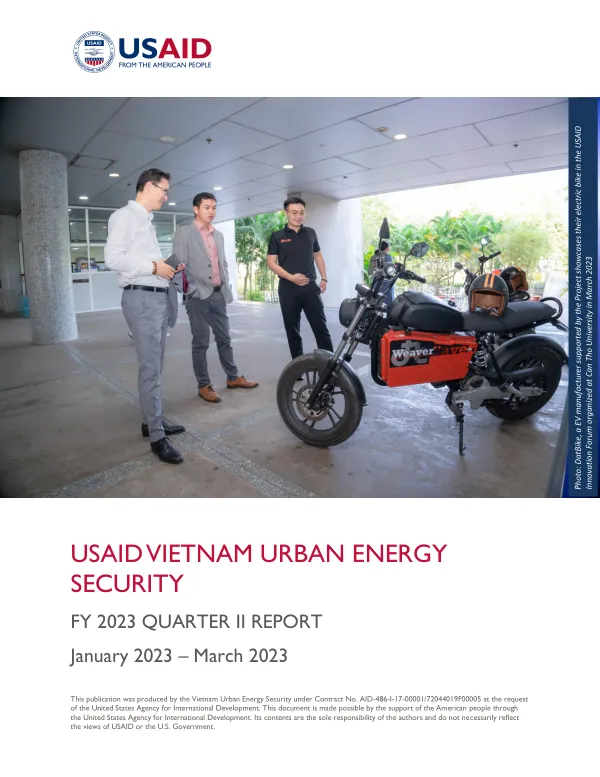
The project aims to achieve three expected high-level results: deploying at least 400 megawatts (MW) of advanced, distributed energy systems, mobilizing at least $600 million in public and private investment for advanced, distributed urban energy systems, and demonstrating and/or commercializing at least 20 innovative solutions to address urban energy and environmental issues. The project is working with the Department of Industry and Trade (DOIT) in both target cities to improve the enabling environment, including policies, regulations, and city-level energy programs, to increase the market size for the deployment of advanced, distributed energy systems. The project also aims to mobilize public and private sector investment for the deployment of advanced, distributed energy systems and increase adoption of innovative technologies, business practices, and financing models for advanced, distributed urban energy solutions. In Quarter II of the fourth fiscal year, the project team accelerated the implementation of activities laid out in the approved Year 3 workplan. The team coordinated with other USAID partners to conduct high-profile events, including a Climate Change Town Hall at Can Tho University, a Green Bond training for key partners, and workshops to kick off a net-zero strategy in Danang and HCMC. The project also organized a launch event for the Energy Efficiency Award (EEA) in Danang and supported DOIT Danang to develop communication materials promoting Earth Hour Campaign 2023. The project continued to deliver the policy dialogue series, holding workshops on "Sustainability-linked Financing" and "Environmental Social Governance (ESG) in Energy Infrastructure" for developers and financial institutions. The project also supported Dat Bike to develop an Environmental & Social Management System in accordance with IFC standards and completed the technical evaluation for Round 3 of the Innovation Challenge Fund (ICF). The project identified and issued requests for proposals (RFPs) for 6 innovative solutions and co-organized a training workshop with HCMC Department of Natural Resources and Environment (DONRE) on greenhouse gas (GHG) inventory and monitoring, reporting, and verification (MRV) system. The project's technical activities are focused on three components: Strengthening the Local Enabling Environment, Unlocking Capital, and Spurring Innovation. The first component focuses on working closely with DOIT and other Government of Vietnam (GVN) counterparts in Danang and HCMC to strengthen their ability to promote and encourage the adoption of renewable energy (RE) and energy efficiency (EE) measures. This will be achieved by providing technical assistance, capacity building, and policy support to the local government and private sector. The second component, Unlocking Capital, aims to mobilize public and private sector investment for the deployment of advanced, distributed energy systems. This will be achieved by providing financial support, risk management, and market development to the private sector and public sector entities. The project will also work with financial institutions to develop innovative financing models and products that support the deployment of advanced, distributed energy systems. The third component, Spurring Innovation, aims to increase adoption of innovative technologies, business practices, and financing models for advanced, distributed urban energy solutions. This will be achieved by providing funding and technical assistance to innovators and entrepreneurs, as well as supporting the development of innovative solutions through the Innovation Challenge Fund (ICF) and other mechanisms. The project's geographic focus is on Danang and HCMC, with a focus on improving urban energy resilience and energy security in these cities. The project's timeframes are from January 2023 to April 2023, with a focus on implementing activities laid out in the approved Year 3 workplan. The project's recommendations include continuing to support the development of innovative solutions, mobilizing public and private sector investment, and strengthening the local enabling environment to promote the adoption of renewable energy and energy efficiency measures.
Related documents