USAID DEC
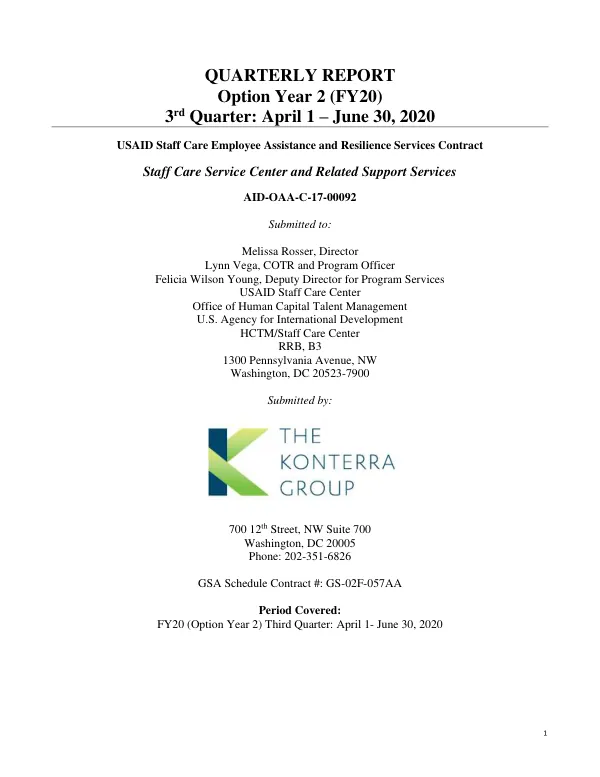
FY20-Q3 Report: USAID Staff Care Employee Assistance and Resilience Services Contract
Sign inUSAID
FY20-Q3 Report: USAID Staff Care Employee Assistance and Resilience Services Contract
Staff Care Services Center (SCSC) supported USAID individuals over 9,521 times during the third quarter of FY20, a 71% increase from the previous quarter.
2020 · 24 pages
Sign in to readA free account is required to download.
Abstract
The primary reason for this significant increase was SCSC's rapid and comprehensive response to two major critical incidents: the ongoing COVID-19 crisis and the murder of George Floyd, an unarmed 46-year-old African American man, by police officers. SCSC increased its outreach efforts during this difficult time and reached 4,119 individuals through the Staff Care Scoop, Staff Care overviews, wellness and work-life promotions, the SCSC Call Center, and email. SCSC's Q3 efforts were devoted to supporting the USAID community during COVID-19. SCSC teams from programmatic areas, including EAP, Organizational Resilience (OR), Resilience Training, and Knowledge Management, worked collaboratively to support staff and family members. SCSC delivered 64 webinars on 26 topics, attended by 2,990 people, and provided EAP facilitation and emotional health support to 667 staff in two Bureaus and the Payne Fellows in the wake of George Floyd's death and worldwide protests. During this time, SCSC supported 252 staff in 8 Missions, providing organizational resilience, team cohesion, and leadership effectiveness, as well as resilience and pre-deployment workshops, EAP counseling, wellness and work-life support. SCSC also provided health and wellness support, coaching, and education for 51 staff and managers, and supported 903 individuals through a 4-week Total Well-being Challenge. The SCSC services resulted in an estimated 237 work days saved, valued at $77,410, and improved individual and team performance, stress, resilience, well-being, job satisfaction, and commitment to USAID. The SCSC continually adapts its services in response to staff needs and demand, including new webinars and resources on individual and organizational resilience, health and wellness, and work-life effectiveness. The top 5 concerns for counseling clients were emotional health, family/relationship concerns, legal issues, workplace concerns, and adjustment/change. The top 5 concerns for work-life clients were emotional health, family/relationship concerns, legal issues, workplace concerns, and adjustment/change. The key themes for Mission/Washington engagements were managing high stress, change, and uncertainty due to COVID-19 and the aftermath of George Floyd's death and protests, and improving team communication and leadership effectiveness. The USAID Missions supported during FY20-Q3 included Afghanistan and Pakistan, which received pre-deployment resilience workshops; Burkina Faso, which received EAP VTC on building resilience; Cambodia, which received wellness VTC on mindfulness and yoga; Djibouti, which received EAP VTC and OR VTC on building resilience and team resilience; El Salvador, which received resilience training and EAP VTC on cultivating compassion and maintaining motivation; and the Resilience Training Advisor and a SCSC Counselor provided 3 webinars for staff on cultivating compassion, maintaining motivation, and mindfulness. The USAID Washington Teams supported during FY20-Q3 included AFR/Senior, which received OR Advisors to discuss leading during COVID-19; Africa Bureau/East Africa, which received EAP/CIR support for the sub-regional virtual meeting to promote resilience in the face of COVID-19 and protests; Africa Bureau/Southern Africa, which received EAP/CIR support for the sub-regional virtual meeting to promote resilience in the face of COVID-19 and protests; and Africa Bureau/West Africa, which received EAP/CIR support for the sub-regional virtual meeting to promote emotional and mental health and resilience in the face of civil unrest and uncertainty due to COVID-19 and protests.