USAID DEC
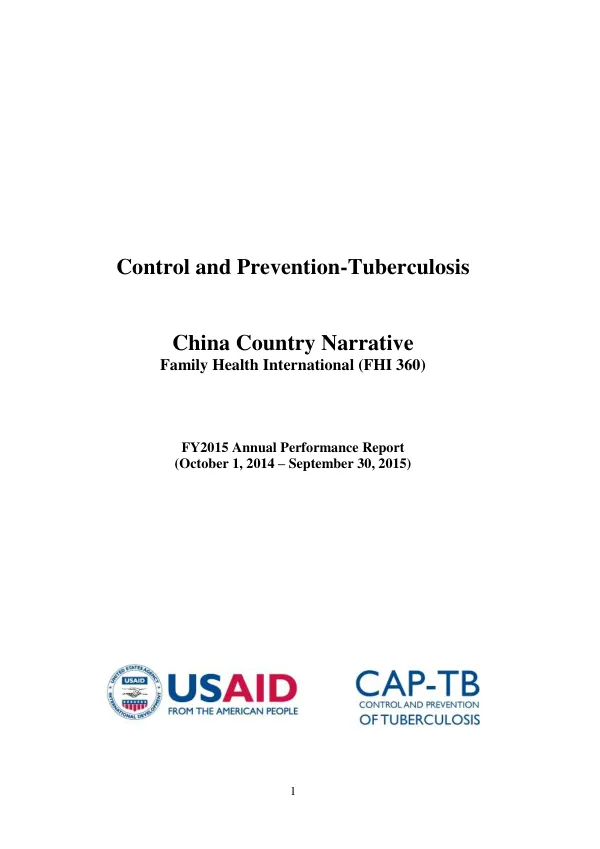
FY2015 Annual Performance Report: Control and Prevention-Tuberculosis China Country Narrative
Sign inFAMILY HEALTH INTERNATIONAL
FY2015 Annual Performance Report: Control and Prevention-Tuberculosis China Country Narrative
The Control and Prevention-Tuberculosis (CAP-TB) China project continued to implement its strategic model from October 2014 to September 2015.
2015 · 16 pages
Sign in to readA free account is required to download.
Abstract
The project's scope of work was expanded to include people living with HIV/AIDS (PLHIV) and geographic expansion to rural Zhenxiong, the county in Yunnan Province with the highest TB notification rate. CAP-TB involved seven new collaborators for FY15, including Yunnan AIDS Initiative (YAI) and Yunnan AIDS Care Center (YACC) for PLHIV, as well as Zhenxiong Center for Disease Control (CDC), Zhenxiong County Hospital, Zhenxiong Shiyan High School, Boji Township Health Center (THC), and Miao Shan village. The Yunnan Anti-TB Association (YATA) continued its leadership role for CAP-TB and partnership with all CAP-TB partners within the public health system and the TB clinical system. The project further strengthened the patient-centered, community-driven strategy, with the goal of integrating this into the existing TB control system in a lasting and cost-effective way. CAP-TB continued to gain recognition at the national and inter-provincial levels throughout China, with additional requests for technical assistance from outside of Yunnan Province. In FY15, community educational activities reached 3,165 people, including 2,774 PLHIV. With the support of the CAP-TB project, Zhenxiong CDC launched its first ever World TB Day (WTBD) campaign, which included a public/volunteer training session, school-based education and exhibition, as well as a community event with strong leadership support of the local county government. The WTBD campaign activities reached 1,100 local people. CAP-TB's success in community education in FY15 was best shown by community engagement of school children in rural Zhenxiong County. At Zhenxiong Shiyan High School, 4,296 students learned about TB during classroom teaching. More than 4,000 students were actively engaged in school-based TB events and community-based activities during their school vacations, including dissemination of TB leaflets or posters, TB education among their family members or neighbors, and rapid assessment of knowledge, attitude, and practice in the community. In addition to community mobilization to raise TB awareness, YATA provided technical support to build capacity for community health workers in Zhenxiong, who were trained to facilitate early uptake of TB services. Pervasive TB stigma remains a major obstacle that may prevent local villagers from being screened, diagnosed, and treated for TB. Based on the findings of a TB stigma study supported by CAP-TB at the end of FY14, community outreach should continue to address TB stigma in order to improve diagnosis, treatment initiation, completion, and cure. Infection control in health facilities was scaled up through the implementation of Standard Operating Procedures (SOPs) for TB infection control in all health facilities in Zhenxiong. The SOPs were developed in collaboration with the Zhenxiong CDC and the Zhenxiong County Hospital. The SOPs included guidelines for the use of personal protective equipment (PPE), the cleaning and disinfection of equipment and surfaces, and the management of TB patients in health facilities. The implementation of the SOPs was monitored through regular site visits and feedback from health facilities. The results of the monitoring showed that the implementation of the SOPs was successful in reducing the risk of TB transmission in health facilities. The SOPs were also disseminated to all health facilities in Yunnan Province, and the Zhenxiong CDC and the Zhenxiong County Hospital provided technical support to other health facilities in the province to implement the SOPs. The CAP-TB project also strengthened the capacity of the Zhenxiong CDC to implement TB infection control measures in communities. The Zhenxiong CDC was trained to conduct TB infection control assessments in communities and to develop and implement community-based TB infection control plans. The project also provided technical support to the Zhenxiong CDC to develop and implement SOPs for TB infection control in communities. The implementation of TB infection control measures in communities was monitored through regular site visits and feedback from community health workers. The results of the monitoring showed that the implementation of TB infection control measures in communities was successful in reducing the risk of TB transmission in communities. The project also provided technical support to other communities in Yunnan Province to implement TB infection control measures. The CAP-TB project also strengthened the capacity of the Zhenxiong CDC to manage TB patients in communities. The Zhenxiong CDC was trained to conduct TB patient management assessments in communities and to develop and implement community-based TB patient management plans. The project also provided technical support to the Zhenxiong CDC to develop and implement SOPs for TB patient management in communities. The implementation of TB patient management measures in communities was monitored through regular site visits and feedback from community health workers.