PEPFAR
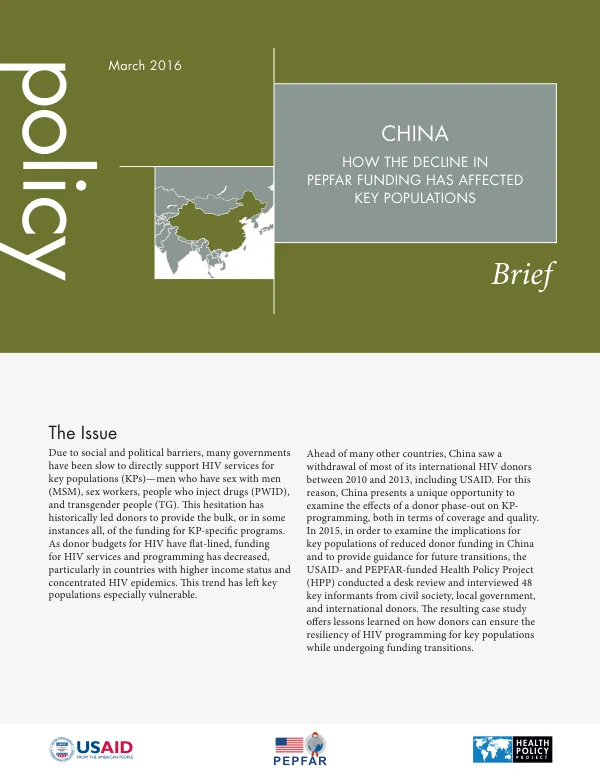
CHINA: How The Decline In PEPFAR Funding Has Affected Key Populations
The decline in PEPFAR funding has had a significant impact on key populations in China.
2016 · 8 pages
Sign in to readA free account is required to download.
Abstract
Key populations, including men who have sex with men (MSM), sex workers (SWs), people who inject drugs (PWID), and transgender individuals (TG), have historically faced social and political barriers in accessing HIV services. As a result, donors have provided the bulk of funding for KP-specific programs. However, with the decline in donor budgets for HIV, funding for KP services has decreased, leaving key populations vulnerable. China's HIV epidemic is concentrated among MSM and PWID, with the highest rates in southwestern provinces such as Sichuan, Yunnan, and Guangxi. According to unpublished studies, there are an estimated 2.76 million PWID, 2.47 million FSW, and 3.83 million MSM residing in China. HIV prevalence has decreased among FSW and PWID, but increasing HIV prevalence among MSM, particularly young MSM, is a cause for concern. In 2014, over a quarter (28.4%) of new HIV infections occurred among MSM, compared to only 2.5 percent in 2006. The legal and social context in China contributes to the vulnerability of key populations. Drug use and sex work are both criminalized, although sex work is better tolerated than drug use, which is highly stigmatized. While same-sex relations are not criminalized, MSM and TG individuals suffer from significant stigma, and there are no laws that protect gender or sexual minorities against discrimination. Civil society organizing is tightly managed and controlled by the Chinese government, making it difficult for HIV civil society organizations (CSOs) to operate independently. The withdrawal of international HIV funding from China between 2010 and 2013 had a significant impact on KP programming. Prior to 2013, China was one of the largest recipients of funding from the Global Fund to Fight AIDS, Tuberculosis and Malaria (Global Fund), receiving US$324 million in HIV funding between 2003 and 2013. However, as an upper-middle-income country, China was no longer eligible to receive grants under the Global Fund's New Funding Model after 2013. PEPFAR provided modest funding to China from 2003-2013 via USAID and the U.S. Centers for Disease Control and Prevention (US-CDC). US-CDC continues to operate an office in Beijing with an annual program budget of US$1.5 million. Despite the decline in PEPFAR funding, China has been able to finance its HIV response through its strong economy. China spends an estimated 5.6 percent of its gross domestic product (GDP) on health expenditures, and the government financed almost all (99%) of its US$987 million in HIV expenditures in 2014. However, the lack of a robust civil society in China complicates reaching key populations, who are highly stigmatized, criminalized, and therefore often reluctant to engage in government-sector services. Community-based services for key populations, provided through peers, are often the preferred service delivery point for these hidden and hard-to-reach populations. The PEPFAR transition in China aimed to develop "replicable intervention models that [could] be adopted and financially supported by the Chinese government as part of the national response." The US-CDC program focused on expanding HIV surveillance systems and linking provincial responses to national-level strategy and policy. USAID's program provided technical assistance in two provinces, Yunnan and Guangxi, focusing on PWID and SWs, and later MSM, in response to China's changing epidemic. However, USAID's national-level programming was limited, and the program was eventually withdrawn in 2011 due to Congressional criticism about providing development assistance to China during the U.S. economic downturn.