CORNELL UNIVARSITY INTERNATIONAL
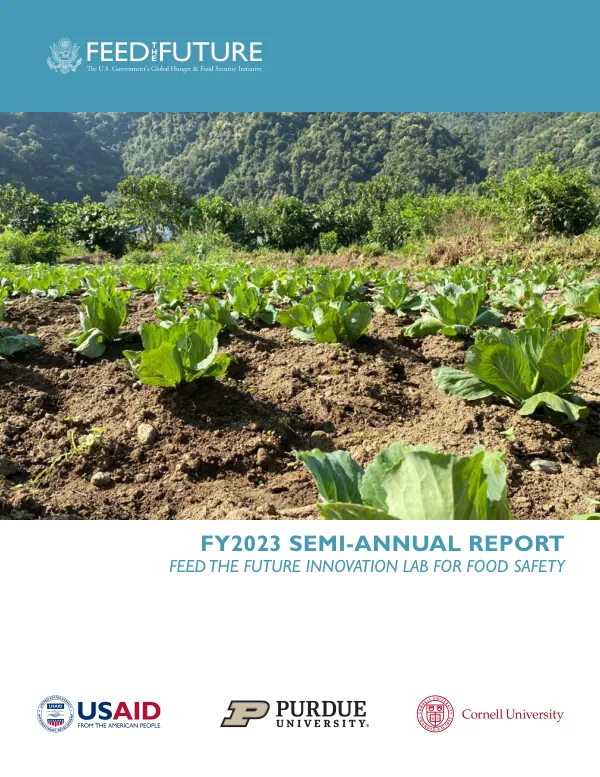
FY2023 Semi-Annual Report Feed the Future Innovation Lab for Food Safety
The Feed the Future Innovation Lab for Food Safety (FSIL) is a research initiative focused on improving food safety in developing countries.
2023 · 18 pages
Sign in to readA free account is required to download.
Abstract
The lab is a collaborative effort between Purdue and Cornell Universities, with funding from the United States Agency for International Development (USAID) under Cooperative Agreement No. 7200AA19LE00003. During the performance period of October 1, 2022, to March 31, 2023, FSIL made significant progress in achieving its objectives. The management entity (ME) objective 1 aimed to maintain high standards in management performance through effective structures, a dynamic and adaptive personnel team, and a culture of open communication within the ME, FSIL research community, and with internal and external stakeholders. To achieve this objective, FSIL held its second hybrid annual meeting in November 2022, which provided an opportunity for subawards to deliver project updates and receive feedback, fostered collaboration among researchers, and emphasized gender and local capacity strengthening. The FSIL management team also conducted monthly meetings with each subaward team to receive updates and address any concerns. Additionally, the Gender Working Group held quarterly meetings to provide an opportunity for project researchers working in the gender space to network and collaborate. FSIL also utilized the Piestar DPx platform to collect and monitor monitoring, evaluation, and learning (MEL) data from subawards. Purdue's Ag Data Services supported subawards with data storage and uploading data to the Harvard Dataverse and USAID's Data Development Library (DDL). FSIL maintained consistent engagement on Twitter, LinkedIn, and Agrilinks, and published e-newsletters quarterly. The Cambodia long-term subaward focused on reducing foodborne pathogen contamination of vegetables in Cambodia. Researchers used a behavior theory approach to better understand producer and consumer perceptions of food safety, which is critical for influencing the adoption of new behaviors and practices. Data analysis was completed, and two manuscripts were submitted for peer-review publication. One manuscript was published in Frontiers in Sustainable Food Systems in March 2023, and the second is currently under review. The Bangladesh long-term subaward aimed to enhance food safety in fish and chicken value chains of Bangladesh. The project team continued to make progress towards understanding safety and quality differences between fish raised following safe management practices and those raised under standard practices and the resulting impact on consumer willingness to pay. Rohu fish that were raised on safer feeds and using best management practices were compared to typical market rohu, and the fish raised with safe practices achieved better results based on preliminary sensory, chemical, and microbial analyses. The Kenya long-term subaward focused on reducing foodborne disease and increasing production of safe foods in Kenya. Researchers made progress in characterizing Salmonella and Campylobacter contamination and the effectiveness of a post-harvest carcass wash intervention in poultry value chains managed by women and youth farmers. They worked with The Ohio State University's Institutional Review Board (IRB) to modify protocols as needed, and they expect to receive IRB approval for baseline microbiological surveys in FY2023 Q3. The Senegal long-term subaward aimed to enhance resilience of the dairy value chain by leveraging public-private partnerships in Senegal. Two baseline surveys were conducted in Dahra (Louga region) to determine production and processing conditions in the dairy value chain and to inform the development of a comprehensive harmonized survey that included food safety, gender, and youth-related topics. The harmonized survey targeted producers, processors, and households and was conducted in Louga, Matam, and Saint Louis. Analysis of the survey results is now underway. The Nepal long-term subaward focused on market-led food safety in Nepal. Researchers made progress in understanding the impact of production incentives on food safety in Nepal. They conducted a literature review and analyzed data from a survey of dairy farmers in Nepal. The results of this work are currently being used to develop food safety education programs that incorporate current beliefs and perceptions of barriers to implementing food safety practices. Overall, FSIL made significant progress in achieving its objectives during the performance period of October 1, 2022, to March 31, 2023. The lab's research initiatives focused on improving food safety in developing countries, with a particular emphasis on reducing foodborne pathogen contamination of vegetables, enhancing food safety in fish and chicken value chains, and promoting market-led food safety in Nepal.