USAID. BUR. FOR POLICY AND PROGRAM COORDINATION. CENTER FOR DEVELOPMENT INFORMATION AND EVALUATION (CDIE)
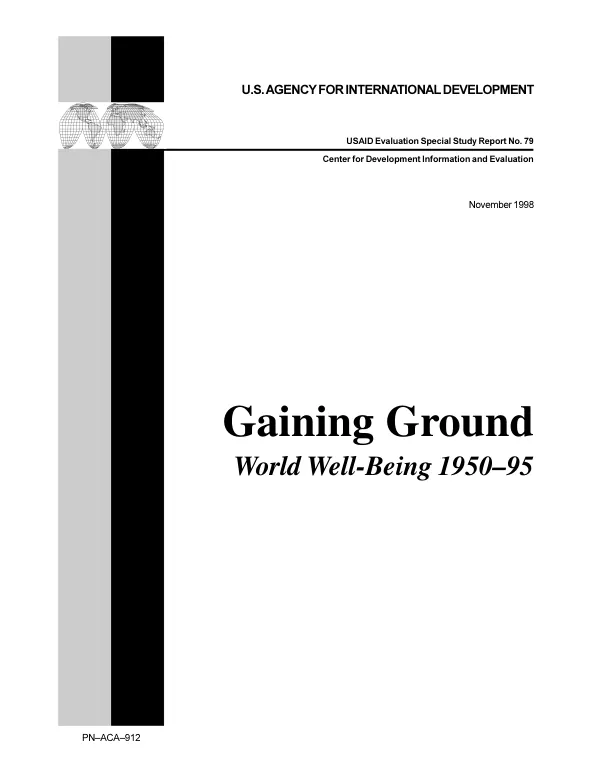
Gaining ground : world well-being 1950-95
Is life for ordinary people in developing countries becoming easier or harder?
Fox, James W. · 1998
Sign in to readA free account is required to download.
Abstract
The conventional view maintains that, while many people have indeed risen out of poverty in some parts of the developing world, a mass of poor people, numbering perhaps 1 billion, have been left behind, and that future prospects are unpromising. As a group, developing countries are seen as falling behind the rest of the world, raising the specter of islands of prosperity, perhaps heavily armed against immigration, in a sea of misery. Even East Asia -- the one region where broad progress against poverty has been incontrovertible -- became in 1997 the source of a new wave of gloomy stories. This paper assess the validity of this picture by bringing together the best available data on indicators of well-being of people in developing countries over the period 1950 through 1995 in terms of infant mortality, life expectancy, food and nutrition, education and literacy, and political freedom. Where appropriate, both the percentage of people in poverty and the absolute number of poor are considered for both the world as a whole and for developing countries. The study looks mainly at the developing countries taken together, although it also includes a limited discussion of gender and regional differences. The basic finding is that the conventional picture is wrong: there has been a steady and dramatic improvement in indicators of the quality of life for ordinary people in developing countries. Throughout the developing world, people are living longer lives, eating better, and are far more likely to be literate than ever before in history. It is even more remarkable that this considerable progress took place in the face of the most rapid population growth rates in developing countries in the history of the world -- rates that peaked in the 1970s and have since been declining. The average woman in the developing world has three children today, compared with six in 1965. Two characteristics of the trends merit special mention. First, average well-being can improve in the absence of growth in per capita incomes. This has happened in Africa for the last two decades, and it happened in Latin America during the 1980s. Rapid economic growth, as in East Asia, is associated with faster improvement in social indicators. It is likely that the steady improvement in social indicators in stagnant economies results from continued dissemination of knowledge and -- because of greater literacy -- a greater capacity to learn. Second, the trends in social indicators show much more stability than do trends in economic indicators. They do not deteriorate simply because of an economic recession or jump sharply because of an economic boom. Again, this is consistent with the idea that transmission of knowledge of better practices is important; such knowledge does not disappear because of economic downturns. The study concludes by emphasizing the importance of these positive trends in counteracting pessimism about or opposition to international development efforts. Includes bibliography.
![Midterm impact evaluation of the consolidation and enhanced livelihood initiative : general report [Volume I]](https://covers.devme.ai/gen/2554.webp)