USAID. BUR. FOR POLICY AND PROGRAM COORDINATION. CENTER FOR DEVELOPMENT INFORMATION AND EVALUATION (CDIE)
Food aid in Honduras : program has become a model for development
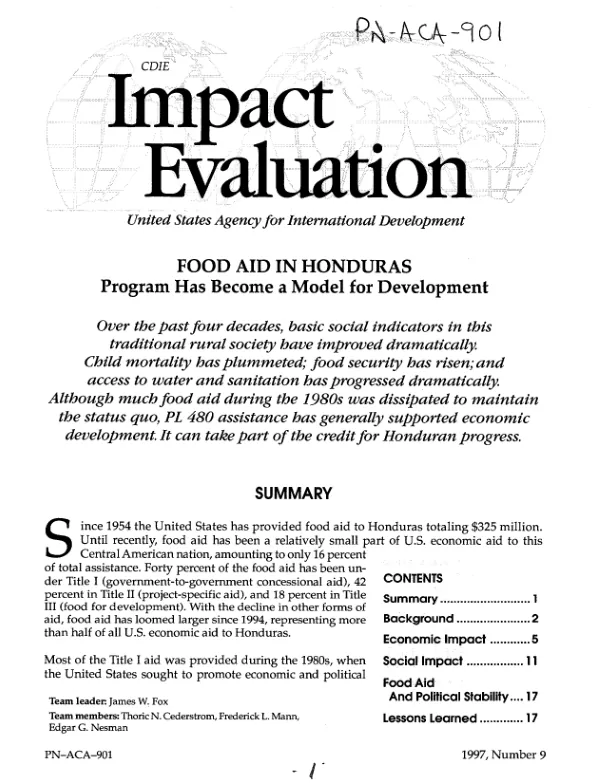
Since 1954, the United States has provided $325 million in food aid to Honduras.
Fox, James W.|Cederstrom, Thoric N. · 1996
Sign in to readA free account is required to download.
Abstract
Of this amount, 40% has been provided under Title I (government-to-government concessional aid, most of it provided during the 1980s), 42% percent has been provided under Title II (project-specific aid), and 18% under Title III (food for development). Although it has accounted for only 16% of U.S. economic aid to Honduras (except for the period since 1994, when it accounted for half), food aid has helped achieve the overriding U.S. foreign policy goal of promoting stability in Honduras and isolating Nicaragua, its southern neighbor. On the other hand, this assistance contributed little to Honduras's long-term development. Successive Honduran governments used the aid to postpone economic reform during the 1980s, notably putting off currency devaluation and thereby raising the ultimate cost of the economic adjustment made after 1990. The Title II programs, including school feeding, maternal and child health, and food-for-work, were probably more effective, although there is little documentation on which to base this judgment; the effects of school feeding programs in particular have been questioned. The maternal and child health and food-for-work programs have probably contributed modestly to the substantial improvement in basic social indicators in Honduras over the past 40 years. Infant mortality, for example, has fallen dramatically, from 157/1000 in 1950 to 42/1000 in 1993. This improvement has been associated with improved access to health services, increased availability of water and sewerage in rural areas, and modest economic growth. Although the development contribution of food aid before 1990 is decidedly mixed, its value since then has been substantial. This increased effectiveness is due to several factors: (1) The shift from Title I to Title III has increased the Mission's ability to program local currency in those areas and for those purposes for which food aid is an effective instrument. (2) Food aid has been closely integrated with the rest of the assistance portfolio and has not been treated as a spigot for transferring additional resources to the country. (3) The major provider of Title II food aid, CARE, has shown adaptability, great concern for effectiveness, and willingness to experiment to increase the development impact of food aid. (4) The Mission has done careful and serious research into the effectiveness of alternative food aid approaches. In addition, the research has sensitized the Honduran government to such approaches and has created a positive climate for better utilization of food aid. The following lessons have been learned: (1) Food aid programs can permit governments to postpone needed economic policy adjustments, thereby delaying the implementation of policies that lead to sustainable development. (2) U.S. food aid can help achieve political stability in the short term by ensuring supplies and reducing food prices. In the Honduran environment, this came at the expense of longer-term development success. (3) Local currency generated from the sale of food aid can contribute to sustainable development when these resources are used to support sound, development-oriented policies and programs or are used by qualified NGOs to fund high-priority development activities. (4) Measuring program performance is important to program success. Where suppositions or hypotheses are not tested against actual outcomes, programs can continue for many years without achieving significant results. (5) While the effect of food aid on nutrition cannot be isolated from other factors, the nutritional effectiveness of food aid has surely increased as better approaches and better targeting toward the at-risk population has occurred. (6) Food aid programs can strengthen local governments and local NGOs. The latter can make important contributions to grass-roots development, participatory development processes, and local empowerment. (7) Food aid need not be an inferior resource if the USAID Mission makes it an integral part of its development program, and if monetization permits sufficient flexibility for good program management. (8) Food aid can be an important vehicle for supporting growth strategies and public resource transfers that differentially benefit lower income groups. (Author abstract, modified)