USAID DEC
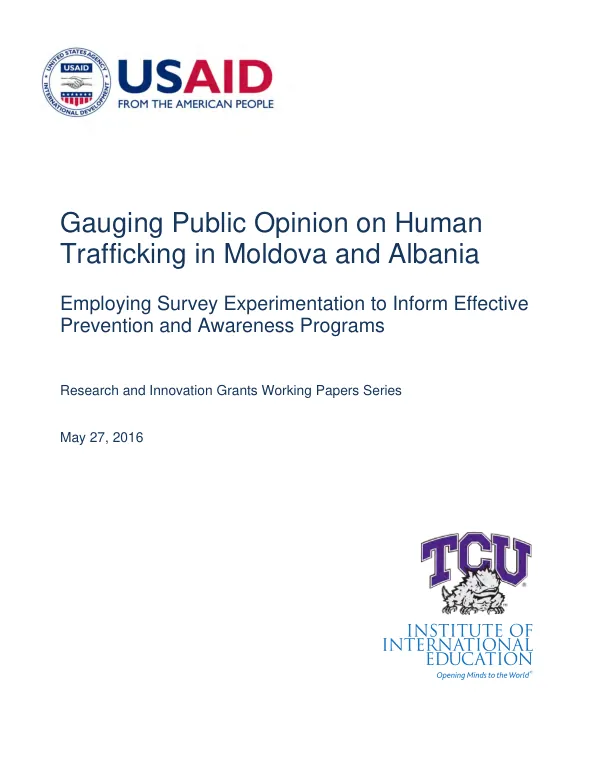
Gauging Public Opinion on Human Trafficking in Moldova and Albania: Employing Survey Experimentation to Inform Effective Prevention and Awareness Programs
Sign inINTERNATIONAL ORGANIZATION FOR MIGRATION
Gauging Public Opinion on Human Trafficking in Moldova and Albania: Employing Survey Experimentation to Inform Effective Prevention and Awareness Programs
Human trafficking is a complex issue that affects various countries, including Albania and Moldova.
2016 · 106 pages
Sign in to readA free account is required to download.
Abstract
Research conducted in these countries aimed to gauge public opinion on human trafficking and inform effective prevention and awareness programs. The study employed survey experimentation to gather data on citizens' attitudes, knowledge, and behaviors related to human trafficking. In both Albania and Moldova, citizens demonstrated varying levels of knowledge about human trafficking. However, they showed a stronger understanding of sex trafficking compared to labor trafficking. Additionally, citizens in both countries were less likely to consider men or boys as vulnerable to human trafficking, indicating a need to broaden the public's understanding of trafficking and awareness of who is at risk. The research also explored the effectiveness of different messaging approaches in promoting behaviors that could limit vulnerability to human trafficking. In Albania, an experiment was conducted to assess the impact of a USAID-funded counter-trafficking program's short video messages on citizens' attitudes and behaviors. The results suggested that messaging that presents information and provides concrete next steps to protect oneself and one's family may be an effective way to promote behaviors that reduce vulnerability to human trafficking. The study's findings have implications for the development of effective prevention and awareness programs in Albania and Moldova. By understanding citizens' attitudes, knowledge, and behaviors related to human trafficking, policymakers and practitioners can design targeted interventions that address the root causes of trafficking and promote behaviors that reduce vulnerability. The research was conducted by a team of researchers from Northeastern University, Texas Christian University, and other institutions, in partnership with the Institute of International Education and USAID. The study is part of the Research and Innovation Grants Working Papers Series, which aims to advance the field of democracy, human rights, and governance through rigorous research and evidence-based programming. The study's methodology involved a survey experiment, which was conducted in Albania and Moldova. The survey gathered data on citizens' attitudes, knowledge, and behaviors related to human trafficking. The experiment also assessed the impact of different messaging approaches on citizens' attitudes and behaviors. The research was conducted by a team of researchers from Northeastern University, Texas Christian University, and other institutions, in partnership with the Institute of