USAID
Connect for Growth (C4G) Quarterly Progress Report
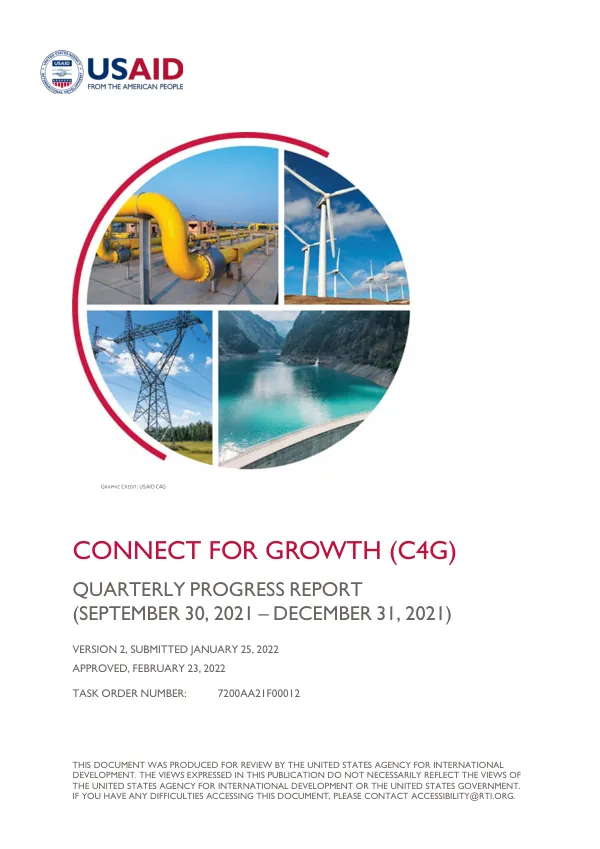
The Connect for Growth (C4G) project, launched on September 29, 2021, aims to strengthen energy security and resilience in the Europe and Eurasia region.
2021 · 23 pages
Sign in to readA free account is required to download.
Abstract
The project is part of the U.S.-Europe Energy Bridge Initiative and is designed to respond quickly and effectively to emerging issues and technical needs impacting the regional energy sector and critical infrastructure in partner countries. The project will provide energy sector expertise to institutions, including ministries, regulatory agencies, utilities, and market operators in Albania, Armenia, Azerbaijan, Bosnia and Herzegovina, Georgia, Kosovo, Moldova, North Macedonia, Serbia, Ukraine, and other countries for which support will impact regional energy security. The project will improve the energy security of partner countries and the region by providing targeted technical guidance and recommendations that advance the following objectives. Objective 1: Strengthened governance of domestic and integrated regional energy markets. This objective covers tasks that support market liberalization and transparency, fair and open procurement practices, cross-border trade, and consumer protection. The tasks include restructuring internal markets, developing and operationalizing regional and sub-regional markets, resolving physical or commercial issues impeding market development and/or integration with European Union (EU) markets, and adopting procurement practices and regulations that increase transparency and fair competition. Objective 2: Reduced dependence on energy sources controlled by malign actors. This objective covers tasks that enhance regional energy security and support planning and investment to reduce the region's dependence on malign-controlled energy sources and financing. The tasks include improving policy, legal, and regulatory frameworks that are necessary to enhance energy security, assessing regulatory and market situations that impact development decisions, preparing pre-feasibility studies and financial and technical analyses for energy and infrastructure upgrades and investments, and facilitating investments in modern and efficient technologies for targeted buildings, industries, and other sectors. Objective 3: Improved energy system resilience. This objective focuses on tasks that ensure energy institutions effectively plan for and respond to emergencies, supply disruptions, other potential threats to system stability, and technological changes impacting the energy sector. The tasks include improving regulatory frameworks and industry practices and standards that impact utility management, operations, and emergency response, monitoring system operations to help prevent, mitigate, and respond to threats to critical infrastructure, preparing risk/threat assessments, technology evaluations, long-term planning documents or strategies, national policies, and internal planning procedures within utilities to improve system resilience, and improving the management and commercial practices of utilities to promote sustainability and resilience. During the reporting period, the project focused on several activities, including project start-up activities, such as staffing, onboarding, work planning, and defining indicators and targets for the project. The project also provided support to the Government of Moldova in response to its seasonal gas crisis and security of supply. The project dispatched a gas specialist to Moldova in November to meet with counterparts and to recommend an appropriate type of support to improve the country's capacity to secure gas supplies from alternative sources. For the next quarter, the project has several priorities, including completing for approval the project's Year 1 Work Plan and Activity Monitoring, Evaluation, and Learning Plan (AMELP), which includes indicators and proposed targets. The project will also finalize the Southeast Europe Energy Strategy and accompanying Western Balkans electricity market and integration assessment. Additionally, the project will continue support to select institutional partners in Moldova on gas issues, as well as the potential placement of one or more embedded advisors within the Government of Moldova. The project will also commence support for Energocom capacity development, after agreeing on the scope and receiving the requested resources.