USAID DEC
GEMS Training Delivery Report: Life of Project Environmental Compliance and Environmentally Sound Design and Management: An Asia Regional Training Workshop for USAID Staff and Implementing Partners
Sign inTHE CADMUS GROUP, INC.
GEMS Training Delivery Report: Life of Project Environmental Compliance and Environmentally Sound Design and Management: An Asia Regional Training Workshop for USAID Staff and Implementing Partners
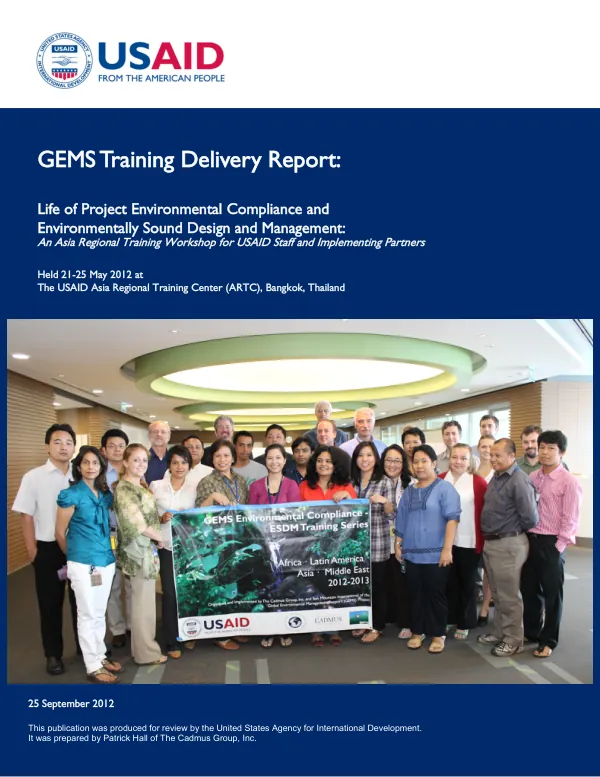
The Asia Regional Training Workshop for USAID Staff and Implementing Partners on Life of Project Environmental Compliance and Environmentally Sound Design and Management was conducted from May 21-25, 2012, at the USAID Asia Regional Training Center (ARTC) in Bangkok, Thailand.
2012 · 28 pages
Sign in to readA free account is required to download.
Abstract
The workshop was hosted by USAID/RDMA and sponsored by USAID/ANE/TS, with key technical assistance provided by the Global Environmental Management Support (GEMS) project. Twenty-eight participants attended the workshop, including 15 USAID mission staff representing 11 missions, including one in the Africa region, and 13 implementing partners representing 10 USAID-funded or linked partners in the region. The workshop was the latest in a series of Asia Regional Environmental trainings for USAID staff, with the overall goal of strengthening environmentally sound design and management of USAID-funded activities in Asia. The workshop used a refined version of the "life of project" agenda, which was first delivered under the ENCAP project in Bagamoyo, Tanzania, in 2008. The agenda was designed to provide participants with the motivation, knowledge, and skills necessary to achieve environmental compliance over the life of the project and to integrate environmental considerations in activity design and management. The workshop was divided into two blocs for approximately one day, with one bloc focused on pre-implementation compliance and the other on compliance during project implementation. The training program was developed by GEMS in consultation with and with key contributions from the USAID facilitation team. Logistics support was provided by GEMS, USAID/RDMA, and ARTC. The workshop achieved its objectives, as indicated by participant evaluations. The training program was designed to provide participants with the skills and knowledge necessary to implement environmentally sound design and management practices throughout the life of the project. The workshop used a progressive approach, beginning with basic skills and addressing the project lifecycle sequentially, from beginning to end. The training concept was consistent with adult learning techniques and a focus on practical application, with group exercises and field visits representing at least 50 percent of total workshop time. The workshop also made use of substantially upgraded training materials for environmental monitoring and EMMP development. The workshop was divided into two main components: upstream compliance and downstream compliance. The upstream compliance component focused on pre-implementation compliance, including the environmental review process defined by Reg. 216, IEE development, and associated EIA skills. The downstream compliance component focused on compliance during project implementation, including the implementation of IEE and EA conditions and the use of the environmental mitigation and monitoring plan (EMMP) as a tool to facilitate this process. The workshop also included a series of Special Topic sessions selected by USAID/RDMA for delivery on Day 4 following the conclusion of the bifurcated upstream/downstream component and field visit. These sessions were selected based on the regional project portfolio and alignment with other workshop training themes. The workshop outcomes were documented in this report, which provides an overview of the workshop's learning approach and structure, outcomes, and key attributes and implementation arrangements. The report is intended to document the workshop's achievements and provide a basis for future improvements in the training program. The workshop was a success, with participant evaluations indicating that the workshop achieved its objectives. The training program was designed to provide participants with the skills and knowledge necessary to implement environmentally sound design and management practices throughout the life of the project. The workshop's outcomes and key attributes and implementation arrangements are documented in this report, which provides a basis for future improvements in the training program. The workshop's success was due in part to the use of a refined version of the "life of project" agenda, which was designed to provide participants with the motivation, knowledge, and skills necessary to achieve environmental compliance over the life of the project and to integrate environmental considerations in activity design and management. The workshop's use of group exercises and field visits, as well as its progressive approach, also contributed to its success. The workshop's outcomes and key attributes and implementation arrangements are documented in this report, which provides a basis for future improvements in the training program. The report is intended to document the workshop's achievements and provide a basis for future improvements in the training program.