BANK FOR WEST AFRICAN DEVELOPMENT
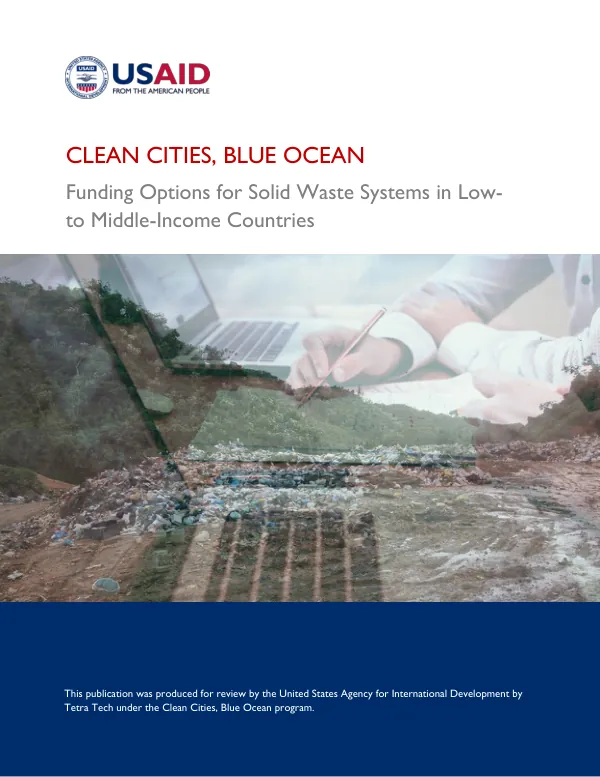
Funding Options for Solid Waste Systems in Low- to Middle-Income Countries
The Clean Cities, Blue Ocean program is a five-year, $48.7 million contract awarded to Tetra Tech by the U.S.
2021 · 42 pages
Sign in to readA free account is required to download.
Abstract
Agency for International Development Bureau of Economic Growth, Education, and Environment. The program aims to address the global crisis of marine plastic pollution by targeting the source of the problem in cities and towns, particularly in rapidly urbanizing areas throughout low- and middle-income countries (LMICs). The objectives of the program are to promote reduce, reuse, recycle (3Rs) and strengthen local and regional markets for recycled plastics, build social and behavior change (SBC) for 3Rs and sustainable solid waste management (SWM), increase capacity and effective governance of SWM and recycling systems, and support international fora, public-private partnerships (PPPs), and multi-stakeholder alliances. Many LMICs have begun to tackle the task of improving 3R and SWM systems to prevent plastics from entering the ocean. However, local governments often bear the main responsibility of making these changes, but the funds allocated to them are often insufficient. This leaves local governments to operate their systems at a substandard level or to seek alternative ways to obtain 3R/SWM revenues to cover the full cost of their system. The issue of improving 3R/SWM systems and identifying funding for such improvements in LMIC countries is not new. International donors and agencies have developed various forms of information and guidance for 3R/SWM system development, including the Asian Development Bank's ISWM for Local Governments Guide, the USEPA's Best Practices for Solid Waste Management in Developing Countries, and the USEPA's Funding Mechanisms for Waste Disposal and Recycling Programs. However, CCBO believes that local governments in LMICs need specific, more tailored guidance around funding of their 3R/SWM systems that can be customized to their local circumstances and opportunities. This guidance would involve a series of resources and hands-on technical assistance, including funding options, local circumstances, and local facilitation. The purpose of this document is to provide local government officials and staff with information on how other local jurisdictions have addressed the issue of funding for their 3R/WSM system. The aim is to provide inspiration and ideas that can be adapted to their own circumstances, enabling local governments to take concrete steps toward establishing new funding that will support an economically sustainable 3R/SWM system. Funding vs. Financing is a critical distinction in the context of 3R/SWM systems. Funding refers to the provision of financial resources, while financing refers to the process of obtaining those resources. Understanding the difference between funding and financing is essential for local governments to identify the most suitable options for their 3R/SWM systems. The Importance of Funding Option Planning is also crucial for local governments. Planning involves identifying the needs and constraints of the 3R/SWM system, as well as the opportunities available for funding. This planning process helps local governments to determine the best funding options for their system. Local governments often have limited funds allocated to them for 3R/SWM systems. However, they can explore various funding options to cover the full cost of their system. These options include self-generated funding, such as waste system fees and taxes, and third-party funding, such as grants and loans from international donors and agencies. Self-Generated Funding Options for 3R/SWM by Local Governments include freeing up funds by improving existing systems, waste system fees and taxes, and the sale of products generated from waste. Local governments can also explore third-party funding options, such as grants and loans from international donors and agencies. The Asian Development Bank's ISWM for Local Governments Guide provides guidance on how to develop and implement 3R/SWM systems in LMICs. The guide emphasizes the importance of involving local communities in the planning and implementation process, as well as the need for strong institutional capacity and effective governance. The USEPA's Best Practices for Solid Waste Management in Developing Countries provides guidance on how to manage solid waste in a sustainable and environmentally sound manner. The guide emphasizes the importance of reducing waste generation, reusing materials, and recycling waste. The USEPA's Funding Mechanisms for Waste Disposal and Recycling Programs provides guidance on how to identify and secure funding for 3R/SWM systems. The guide emphasizes the importance of understanding the needs and constraints of the system, as well as the opportunities available for funding. In conclusion, the Clean Cities, Blue Ocean program aims to address the global crisis of marine plastic pollution by targeting the source of the problem in cities and towns, particularly in rapidly urbanizing areas throughout LMICs. Local governments often bear the main responsibility of making changes to 3R and SWM systems, but the funds allocated to them are often insufficient. This document provides guidance on how to identify and secure funding for 3R/SWM systems, including self-generated funding options and third-party funding options.
Related documents
Documents in this collection
 2021
2021USAID DEC
Final Report: Stronger Together by Learning Together: Learnings from Supporting Academic Partnerships - STAR Collaboration Laboratory
Open record 2017
2017USAID DEC