MIDWEST UNIVERSITIES CONSORTIUM FOR INTERNATIONAL ACTIVITIES, INC. (MUCIA)
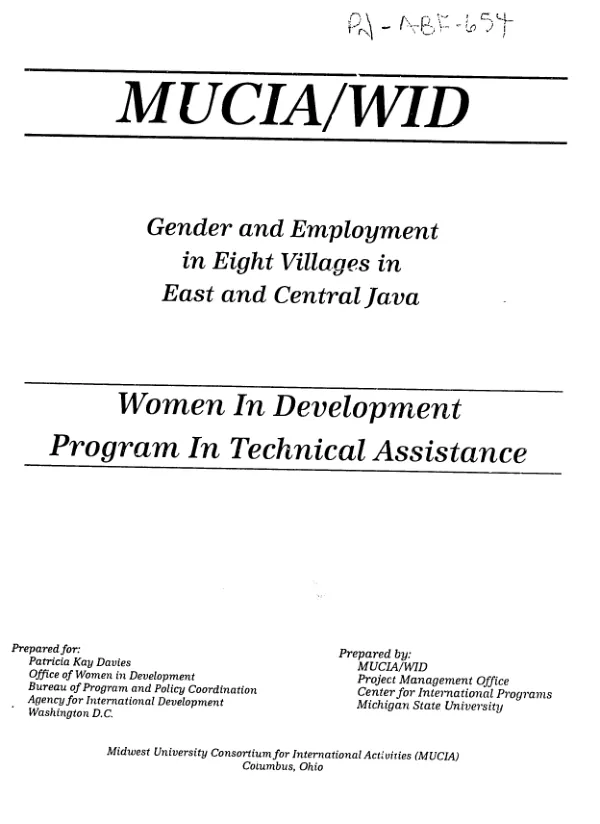
Gender and employment in eight villages in East and Central Java : final report
This study employs a gender-sensitive analysis to examine employment patterns in eight villages in rural Java, Indonesia.
Gray, Denice; Whittier, Patricia · 1990
Sign in to readA free account is required to download.
Abstract
Many studies have noted the decreasing demand for agricultural labor in rural Indonesia and that this decreasing demand is likely to affect women disproportionately, particularly older and less educated women. Recognizing that women are not a homogeneous group, this analysis incorporates the factors of age, education, and class since all of these may affect women"s access to employment opportunities. In addition, this study pays particular attention to female-headed households since women in such households may differ significantly in their opportunities and constraints from their counterparts in male-headed households. The data used in this analysis include those from a 1981 survey of six lowland villages in East and Central Java and comparable 1988 data from the same villages as well as 1988 data from two upland villages. Key findings include the following. (1) Contrary to expectations, there were no major changes in women"s employment in rice production or in wage labor in agriculture from 1981 to 1988. (2) The only areas of agriculture in which participation increased (for both women and men) were perennial crop production and livestock production. (3) In other sectors of the economy, with the exceptions of trade and home industry, women"s participation has increased, although participation rates remain low. (4) The presence of young children in the household significantly increases the number of hours of labor women contribute to the household sector but does not significantly decrease the number of hours of labor they contribute to other sectors. This suggests that women bear a dual burden as well as performing a "dual role" in society. As the direction of the Indonesian economy changes with the government"s emphasis on labor-intensive industry and export production to be located in rural areas, new employment opportunities will be available for rural women. Programs and policies should be designed to promote the ability of all women, not only the young and the well educated, to avail themselves of these opportunities. (Author abstract)
Related documents