USAID
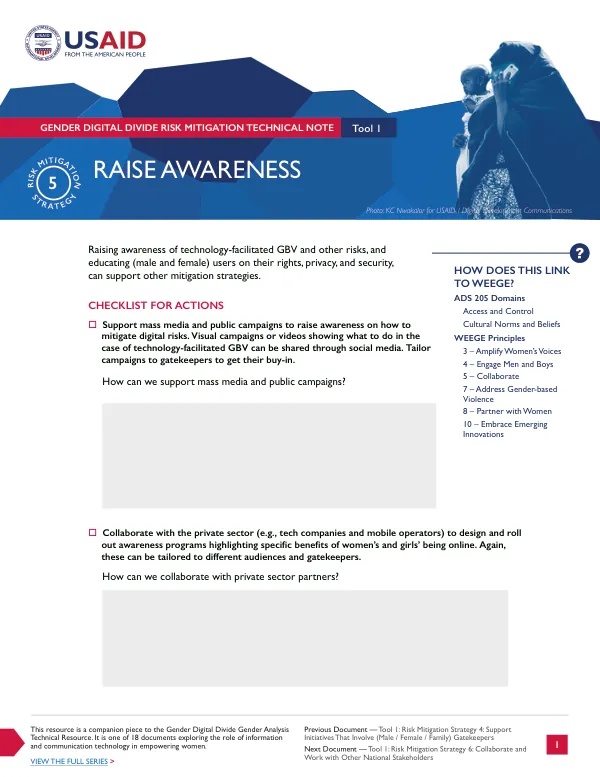
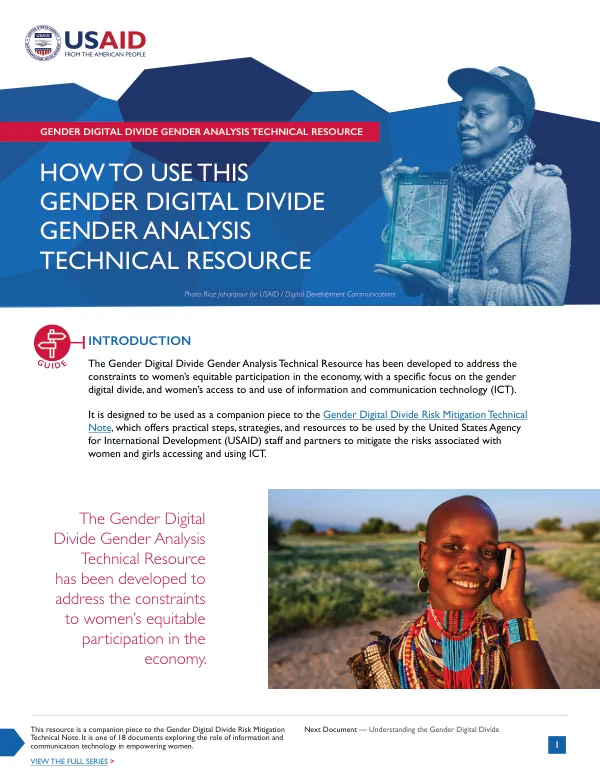
Gender Digital Divide Risk Mitigation Technical Note
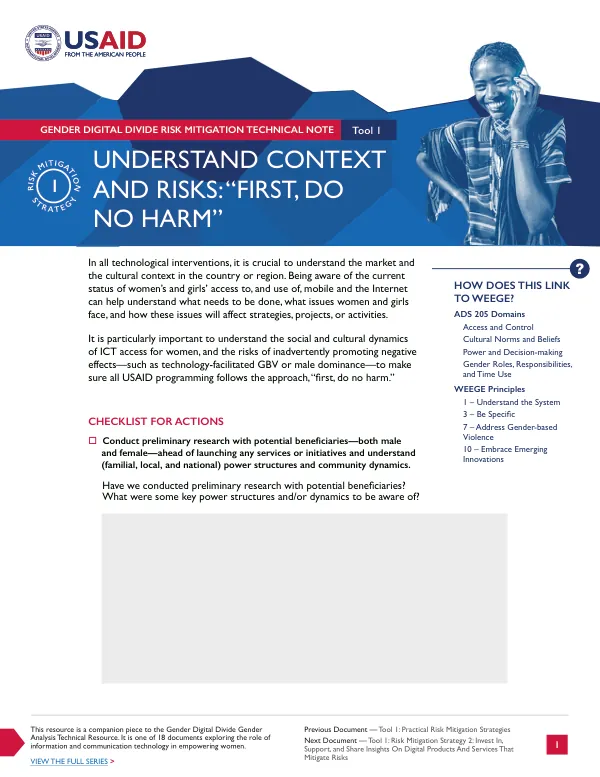
Understanding the social and cultural context of a country or region is crucial when implementing technological interventions.
2021 · 5 pages
Sign in to readA free account is required to download.
Abstract
This includes being aware of the current status of women's and girls' access to and use of mobile and the Internet. Recognizing the social and cultural dynamics of ICT access for women is essential to avoid inadvertently promoting negative effects, such as technology-facilitated GBV or male dominance. The "first, do no harm" approach is a guiding principle for USAID programming. This approach emphasizes the importance of understanding the context and risks associated with ICT use among women and girls. The WEEGE (Women's Empowerment in the Digital Economy) framework provides a lens for conducting gender analyses and identifying potential risks and mitigation strategies. The WEEGE framework consists of 10 principles, including understanding the system, being specific, addressing gender-based violence, and embracing emerging innovations. These principles are used to guide the development of risk mitigation strategies, which are essential for ensuring that ICT interventions do not exacerbate existing gender inequalities. Risk mitigation strategies involve conducting preliminary research with potential beneficiaries, including both men and women, to understand power structures and community dynamics. This research helps identify key social, cultural, and gender norms and roles within the community, as well as the power brokers and transitional moments of influence. Exploring the community's experiences with other gendered concerns, such as child marriage and girls' education, can also provide valuable insights for developing effective risk mitigation strategies. Working with women to understand their information needs and aspirations is also essential for identifying entry points for ICT interventions. Several tools and resources are available to support the development of risk mitigation strategies, including the USAID Gender and ICT Survey Toolkit and the Global System for Mobile Communication Association's (GSMA) Connected Women's Women and Internet Research Toolkit. These tools provide practical advice and guidance on conducting research with women and girls, as well as measuring and understanding women's Internet access and use. The Alliance for Affordable Internet's Meaningful Connectivity Standard is another resource that aims to set a new standard for meaningful Internet access and use. This standard focuses on the quality of connectivity, rather than just the number of people online, and provides a framework for measuring and evaluating the effectiveness of ICT interventions. Ultimately, the goal of risk mitigation strategies is to ensure that ICT interventions do not exacerbate existing gender inequalities, but rather promote women's empowerment and digital inclusion. By understanding the context and risks associated with ICT use among women and girls, and by developing effective risk mitigation strategies, it is possible to create a more inclusive and equitable digital landscape.
Related documents