USAID
Gender Digital Divide Gender Analysis Technical Resource
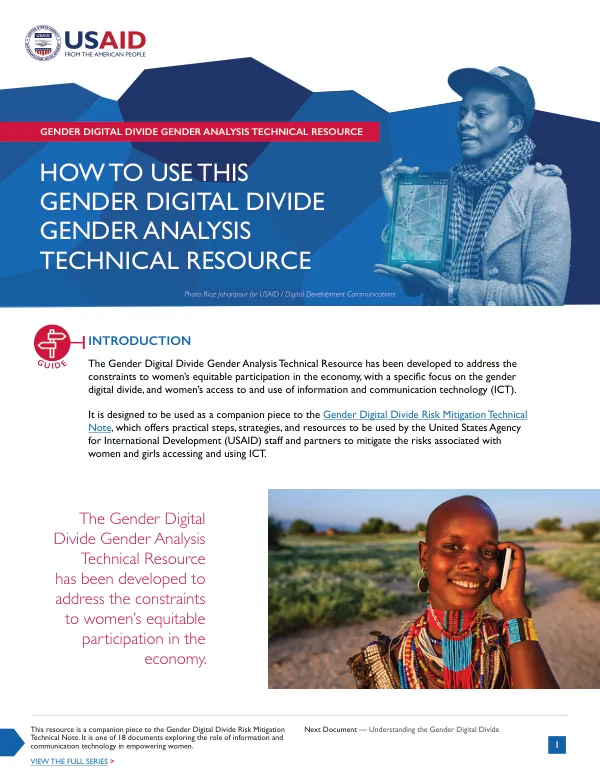
The Gender Digital Divide Gender Analysis Technical Resource is a companion piece to the Gender Digital Divide Risk Mitigation Technical Note, developed to address the constraints to women's equitable participation in the economy, with a specific focus on the gender digital divide.
2021 · 8 pages
Sign in to readA free account is required to download.
Abstract
The resource is designed to be used by the United States Agency for International Development (USAID) staff and partners to mitigate the risks associated with women and girls accessing and using information and communication technology (ICT). The resource defines key terms and concepts, including big data, cybersecurity, data privacy, digital economy, digital finance, digital literacy, and technology-facilitated gender-based violence (GBV). It also provides definitions for mobile ownership, access, and use, as well as mobile money and women's economic empowerment and gender equality (WEEGE). The resource highlights the importance of ICT in enabling access to critical health services, education, civic participation, employment, entrepreneurship, and access to finance. It also notes that the cost of digital exclusion is increasing, and the gap between the digital "haves" and "have nots" is a gap in income, opportunity, education, and wealth. According to the resource, there is a large global gender digital divide in women's access to and use of ICT, with more than half of the world's women being offline. In developing countries, the Internet penetration rate for women on all devices is 40.7 percent, compared to 52.8 percent for men. Additionally, 300 million fewer women than men use mobile Internet, a gender gap of 20 percent. The resource also notes that there is a significant gap in women's meaningful use of mobile, with women tending to use mobiles and mobile Internet differently and often less frequently than men. The main reasons for these gaps are affordability, lack of infrastructure and access, digital literacy and skills, education and literacy, social norms, concerns about risks of security and harassment, and a lack of relevant content. The resource emphasizes the need to address these gaps and promote women's access to and use of ICT to achieve women's economic empowerment and gender equality. It provides a framework for understanding the gender digital divide and identifying strategies to mitigate its risks and promote women's participation in the digital economy.
Related documents