TETRA TECH ARD, INC.
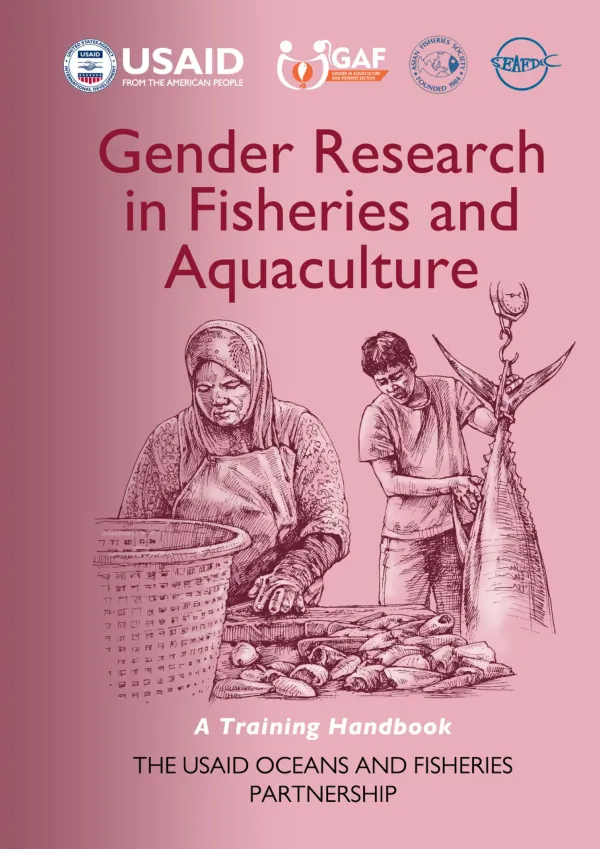
Gender Research in Fisheries and Aquaculture: A Training Handbook
The USAID Oceans and Fisheries Partnership is a five-year activity that aims to strengthen regional cooperation to combat illegal, unreported, and unregulated (IUU) fishing and conserve marine biodiversity in the Asia-Pacific region.
2018 · 67 pages
Sign in to readA free account is required to download.
Abstract
This partnership is between the U.S. Agency for International Development (USAID), the Southeast Asian Fisheries Development Center (SEAFDEC), and the Coral Triangle Initiative for Coral Reefs, Fisheries and Food Security (CTI-CFF). The partnership works with public and private sector partners across Southeast Asia to develop and implement electronic catch documentation and traceability systems, improve sustainable fisheries management using an Ecosystem Approach to Fisheries Management, address human welfare and gender equity concerns, and develop public-private partnerships in support of these efforts. The partnership focuses on developing and implementing electronic catch documentation and traceability systems to combat IUU fishing. This involves working with public and private sector partners to develop and implement systems that track the origin, movement, and sale of fish and seafood products. The partnership also aims to improve sustainable fisheries management by promoting the use of an Ecosystem Approach to Fisheries Management. This approach considers the social, economic, and environmental impacts of fishing activities and aims to ensure that fisheries are managed in a way that is sustainable and equitable. The partnership also addresses human welfare and gender equity concerns in the fisheries sector. This involves working with women and other marginalized groups to identify and address the challenges they face in the fisheries sector. The partnership aims to promote gender equity and improve the livelihoods of women and other marginalized groups in the fisheries sector. The partnership has developed a training handbook on gender research in fisheries and aquaculture. The handbook provides guidance on how to conduct research on gender and fisheries, including how to use intersectionality in research and how to analyze the results of research. The handbook also includes case studies on women in fish border trade in Cambodia, women traders and processors in Mumbai, and small-scale fishers under restriction in response to trade rules on IUU fishing. The handbook is a result of collaboration between USAID Oceans and the Organizing Committee of the 7th Global Conference on Gender in Aquaculture and Fisheries (GAF7). The handbook acknowledges the intellectual contribution of world-renown experts in gender research, working in aquaculture and fisheries, as well as broader disciplines such as agriculture, development, economics, feminist theories, markets and trade, sociology, and socio-political spheres. The handbook is a valuable resource for researchers, policymakers, and practitioners working in the fisheries sector. It provides guidance on how to conduct research on gender and fisheries, and how to use the results of research to inform policy and practice. The handbook is also a useful tool for promoting gender equity and improving the livelihoods of women and other marginalized groups in the fisheries sector. The partnership has also developed a range of tools and techniques for conducting research on gender and fisheries. These include participatory gender resource mapping, which involves working with women and other marginalized groups to identify and analyze the resources and challenges they face in the fisheries sector. The partnership has also developed a range of templates and guidelines for conducting research on gender and fisheries, including guidelines for conducting key informant interviews and focus group discussions. Overall, the USAID Oceans and Fisheries Partnership is a valuable initiative that aims to promote sustainable fisheries management and improve the livelihoods of women and other marginalized groups in the fisheries sector. The partnership's training handbook and range of tools and techniques provide a valuable resource for researchers, policymakers, and practitioners working in the fisheries sector.