DEPARTMENT OF HEALTH
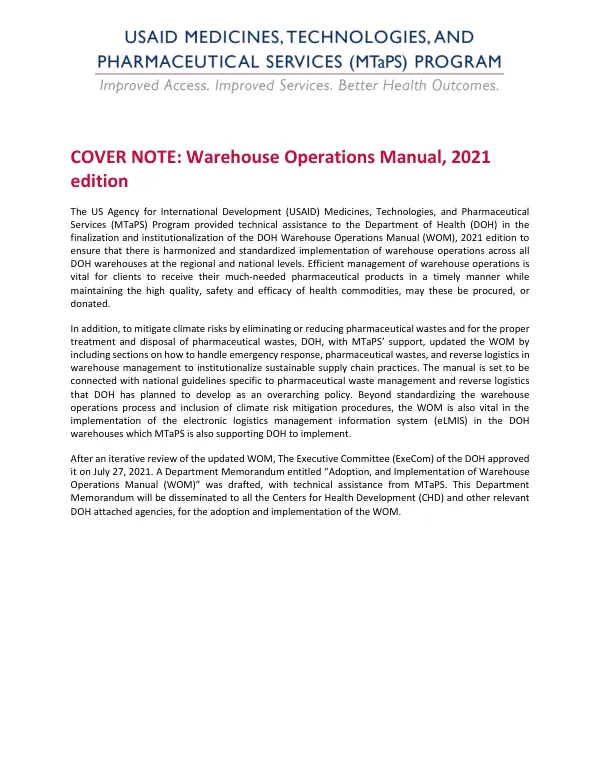
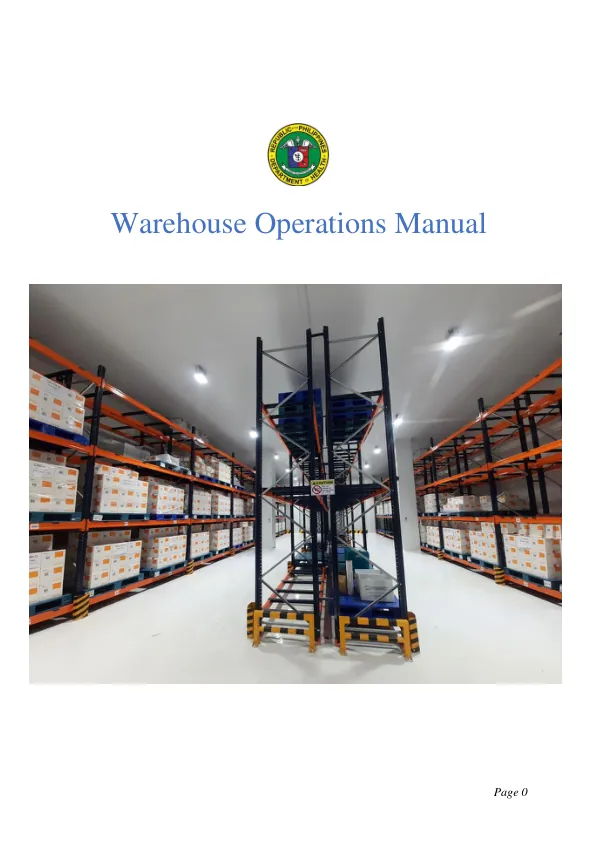
Warehouse Operations Manual
The Warehouse Operations Manual is a comprehensive guide for managing warehouses in the Department of Health's Supply Chain Management Service.
2021 · 118 pages
Sign in to readA free account is required to download.
Abstract
The manual is an essential component of the supply management system, aiming to ensure the availability and accessibility of safe and effective health commodities across the country. The manual is a result of the ongoing reforms in the Department of Health, particularly the implementation of the Universal Health Care (UHC) Act. The UHC Act marked a significant milestone in the Philippine health sector, paving the way for significant reforms in the entire healthcare system. To achieve this, a systematic approach and clear delineation of roles of key agencies and stakeholders are necessary to improve the performance of the health systems. The manual is designed to provide guidelines for supply management, which is a critical component towards achieving accessibility to quality health products at the service delivery points. The manual outlines the roles and responsibilities of the supply workforce and harmonizes the concept of managing health commodities across warehouses managed by the government. The manual is divided into several parts, including an introduction, guiding principles, standard operating procedures, and a list of references. The standard operating procedures cover various aspects of warehouse management, including preparation for delivery, receiving of commodities, put-away, storage and warehousing, pick and pack, dispatch, waste management, reverse logistics, emergency supply chain management, and cold chain management. The manual is intended for use by the warehouse workforce, as well as local government units, to guide them in performing daily warehouse operational tasks. The ultimate goal of the manual is to provide patient-centered care to Filipinos in support of the developments in the health sector as embodied in the Philippine Health Agenda and UHC. The manual is also designed to support the national sector program on UHC implementation within the area-wide approach under government leadership. Particular consideration is given to critical challenges to increase the capacity and commitment of local governments to deliver health services and to ensure effective and sustainable implementation of health reforms across the country. The Supply Chain Management Service developed the manual as an important part of the Supply Chain Management as a support to Service Delivery of Health Programs. The SCMS team assumes the technical leadership and steers the coordination of initiatives to strengthen the country's Supply Chain Management, from the national down to the local government level, which ultimately aims to ensure the delivery of patient-centered quality care. Standardization of processes and key areas of warehouse management is a step towards ensuring uniformity of warehouse processes at all levels of supply chain in preparation to achieving digitalization of supply management processes. This is through the implementation of the Electronic Logistics Management Information System (eLMIS) which will provide a more efficient, real-time, accurate data gathering and data management for monitoring, evaluation of the country's supply chain for a more informed decision making. The Department of Health would like to acknowledge the leadership, expertise, support, and contributions of various individuals and organizations that made the development of this manual possible. The manual is a testament to the Department's commitment to improving the supply chain management system and ensuring the availability and accessibility of safe and effective health commodities across the country.
Related documents