USAID. MISSION TO INDONESIA
General participant training II
Summarizes attached interim evaluation (XD-ABC-534-A) of a project to provide participant training to upper-level policy and management personnel in Indonesia.
1991
Sign in to readA free account is required to download.
Abstract
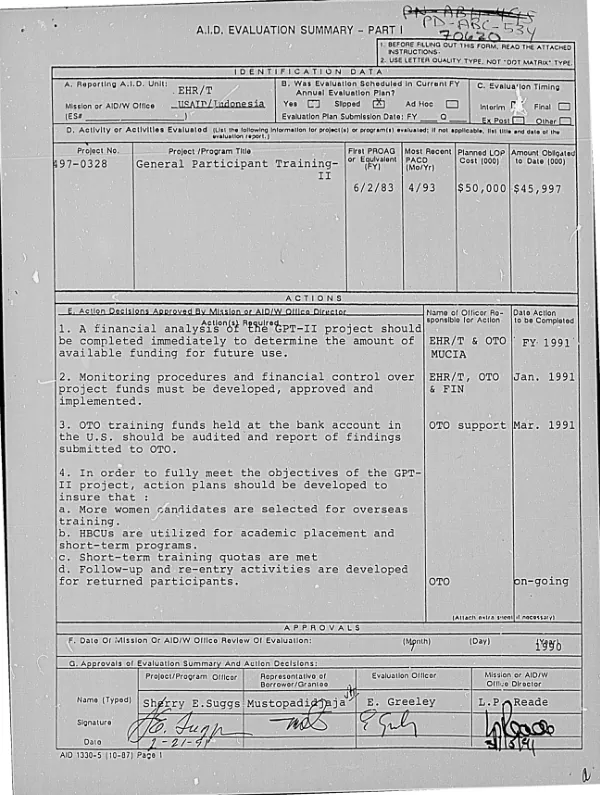
Evaluation covered the period 3/88-7/90. The project has made significant progress towards achieving its objectives. The general participant training component has met or exceeded its targets for long-term academic training: to date, 683 participants have completed training and 324 are in training. However, it is behind schedule on the special concerns listed in Amendment 3 to the project: the participation rate of women, at 19%, is below the target of 25%; the use of short-term, non-academic courses is little more than half the targeted amount; and no participants have as yet been recruited from the private for-profit sector. The institution-building objective has been realized in the creation of an Indonesian Overseas Training Office (OTO). The OTO has made significant progress in developing selection, preparation, placement, and monitoring procedures for overseas training; has been given formal status as a specialized agency within the National Planning and Coordinating Board; and has attracted funding from other international donors. On the negative side, its dependence on USAID and other donors and lack of a broad national client base in Indonesia threaten its long- term sustainability. The most immediate problem facing the project is financial. Due to lack of adequate monitoring and controls, the exact amount of available funds is unknown, but is estimated to be barely enough to cover the next batch of participants. Additionally, the growth of the Indonesian economy has increased the need for mid- level managerial and technical skills. For the longer-term, OTO"s main problem is to ensure an adequate pool of qualified candidates. The current selection process is too restrictive and is likely to foster unproductive competition among donors for promising candidates. Action decisions are to: (1) determine at once the amount of available funds and develop monitoring and control procedures over project funds; (2) audit the OTO training funds held at the bank account in the United States; and (3) develop action plans to select more women for overseas training, use Historically Black Colleges and Universities for academic placement and short- term programs, meet short-term training quotas, and develop follow-up and re-entry activities for returned participants.
Related documents