USAID DEC
Genetic improvement of productivity and nutritional quality of wheat; University of Nebraska
Sign inUSAID. BUR. FOR SCIENCE AND TECHNOLOGY. OFC. OF AGRICULTURE
Genetic improvement of productivity and nutritional quality of wheat; University of Nebraska
Evaluates project to develop wheat varieties with high percentages of protein and of high lysine in protein without yield loss.
1980
Sign in to readA free account is required to download.
Abstract
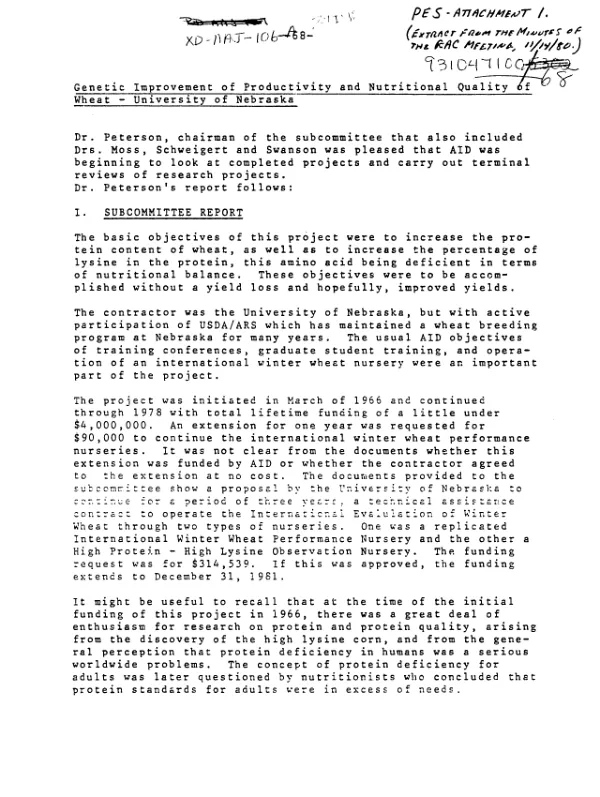
Evaluation covers the period 6/66-12/79 and consists of a review of the contractor's final report by a subcommittee of A.I.D.'s Research Advisory Committee (RAC). University of Nebraska researchers succeeded in developing a stock of parent plant materials high in protein and lysine content for cultivation in developing countries. Examples include Bezostaya 1 (a Russian variety) and Bolal (developed at Nebraska) for Turkey and a French-Hungarian variety for Afghanistan. Researchers also bred varieties that were -- contrary to initial assumptions -- both high-yielding and high in protein, e.g., Lancota, which was distributed commercially in the United States. Researchers could not, however, find sufficient variability in lysine content to make breeding for high lysine as a percentage of protein a viable objective. Other outputs included the holding of four international wheat conferences, publication of 65 documents, and the training of 10 foreign scientists. Although a network of test nurseries was established with 68 test sites in 38 countries, most sites were located in countries not listed in the "need" category. The project's actual impact on developing country wheat production thus remains unclear, as does the country of origin or current responsibility of the 10 project trainees. In light of these considerations, it is recommended that any work beyond initial research be conducted within the country where the application is to be made; that methods of assessing the actual adoption of selected varieties, as well as the extent of acreage of the variety in-country, be developed; and that the funding of the nursery network be continued in order to best disseminate research findings. It was further recommended that A.I.D. and RAC be more discriminating when continuing projects which have served their primary purpose. The response to the discovery that the original project breeding objective was not a viable one should have been a narrowing of scope rather than the introduction of new objectives.
Related documents