USAID DEC
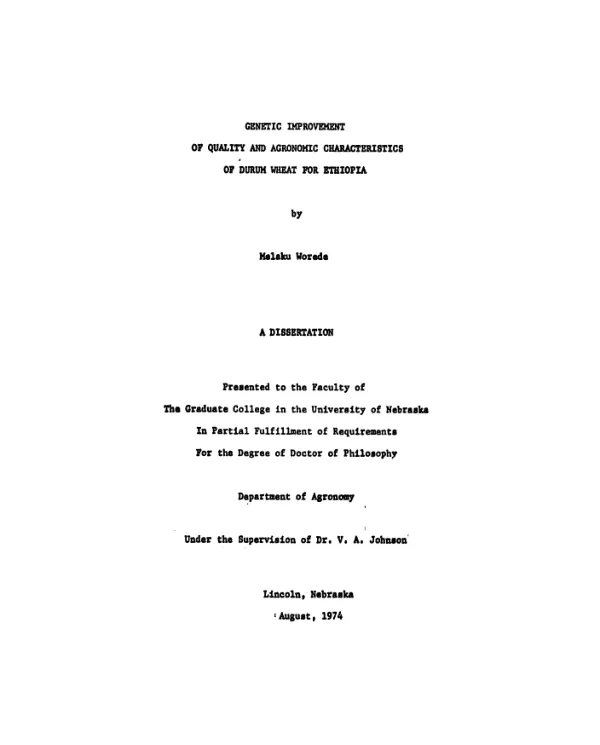
Genetic improvement of quality and agronomic characteristics of durum wheat for Ethiopia
Sign inUNIVERSITY OF NEBRASKA AT LINCOLN. DEPT. OF AGRONOMY
Genetic improvement of quality and agronomic characteristics of durum wheat for Ethiopia
The T.
Worede, Melaku · 1970
Sign in to readA free account is required to download.
Abstract
Durum segment of the U.S.D.A. World Wheat Collection totalling 3399 lines was analyzed to study the variability that exists for protein and lysine among durum wheats. Substantial variability in protein content among these tetraploid wheats was detected. Protein varied from 7.3% to 21.3% with a mean and standard deviation of 12.75% and 2.86%, respectively,. Lysine (% of sample) ranged from 0.26% to 0.60% with a mean of 0.39% and standard deviation equal to 0.06% Lysine expressed is percent of protein exhibited a range of 2.43% to 4.29% with a mean and standard deviation of 3.15% and 0.27%, respectively. These protein and lysine values closely resemble the values for common wheats and other Triticum species and genera related to wheat. The nature of the distribution, amount of variability, and the relationship of protein and lysine in these two species also are similar. The magnitude of the correlation between these two traits is, however, larger in durum wheats than in the hexaploid wheats. The relationship of lysine (% protein) with protein content is strongly positive and curvilinear (4E2=.92). Lysine (% protein) is negatively correlated with protein with about 75% of its variation being associated with protein variation. The negative relationship of lysine (% protein) and protein content diminishes as protein increases, and virtually disappears above 15% protein.