USAID DEC
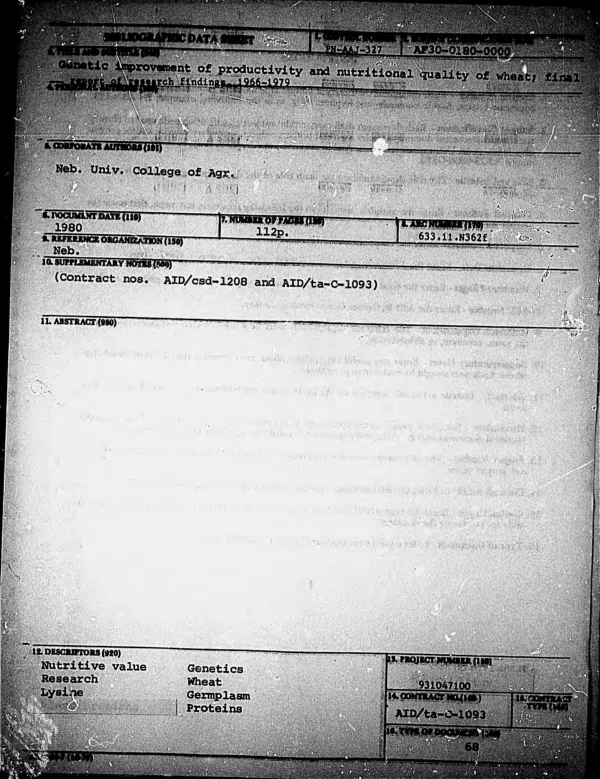
GENETIC IMPROVEMENT OF PRODUCTIVITY AND NUTRITIONAL QUALITY OF WHEAT; FINAL REPORT OF RESEARCH FINDINGS, 1966-1979
Sign inUNIVERSITY OF NEBRASKA AT LINCOLN. COLLEGE OF AGRICULTURE
GENETIC IMPROVEMENT OF PRODUCTIVITY AND NUTRITIONAL QUALITY OF WHEAT; FINAL REPORT OF RESEARCH FINDINGS, 1966-1979
Food to nourish the world"s population, which will reach 6.5 billion by the year 2000, transcends all other problems confronting countries and governments.
1970
Sign in to readA free account is required to download.
Abstract
To help increase world food production, A.I.D. funded a research project to genetically engineer high protein wheat (HPW) at the University of Nebraska from 1966 to 1979. This final report summarizes the project"s research findings. Analyses of 20,000 wheat cultivars showed that genetic variation for HPW of at least 5% exists in hexaploid wheat; genetic variation for lysine (LYS) amounts to only 0.5%; LYS, as a percent of HPW, correlates negatively with HPW at protein levels up to 15%; and a strong positive correlation exists between LYS per unit weight and grain protein content. Major genes affecting grain HPW content were identified in Atlas 66 and Nap Hal. Genes modestly affecting LYS were found in CI13449 and Nap Hal. Hybridized genes were transferred to productive short-statured winter and spring wheats. High-yield varieties developed included Lancota (a hard winter variety), Sava and Partizanka (Yugoslavia), Kavkaz and Aurora (the Soviet Union), and Centurk (Nebraska). Genetic studies indicate that Atlas 66 carries two or more major genes for HPW. Genetic increases in LYS provided by CI13449 and Nap Hal, while limited, are great enough for use in breeding programs and for overcoming the decrease in the fractional percent of LYS in HPW due to HPW"s overall increase. Laboratory procedures were developed to streamline the large-scale screening of HPW and LYS samples. Tests showed that Atlas 66 and its HPW derivatives, when consumed whole-grain, are significantly more nutritional than ordinary wheat. Significant associative nitrogen fixation could not be shown for Nebraska wheat. Other project activities included establishment of an international winter wheat evaluation network; the holding of four international wheat conferences and an international workshop on seed HPW; and the provision of degree and nondegree training to 29 researchers, 14 of them from developing countries. The report concludes by noting that, since yields will soon regress without ongoing breeding programs, A.I.D."s decision to cease funding the project is regrettable.
Related documents
Documents in this collection
 1970
1970USAID DEC
Reevaluation of common wheats from the USDA world wheat collection for protein and lysine content
Open record 1970
1970USAID DEC