USAID DEC
Genetic parameters and genomic regions associated with growth rate and response to Newcastle disease in local chicken ecotypes in Ghana and Tanzania
Sign inHUAZHONG AGRICULTURAL UNIVERSITY
Genetic parameters and genomic regions associated with growth rate and response to Newcastle disease in local chicken ecotypes in Ghana and Tanzania
Local chicken breeds play a significant role in the livelihoods of people in both rural and urban areas of Africa.
2018 · 6 pages
Sign in to readA free account is required to download.
Abstract
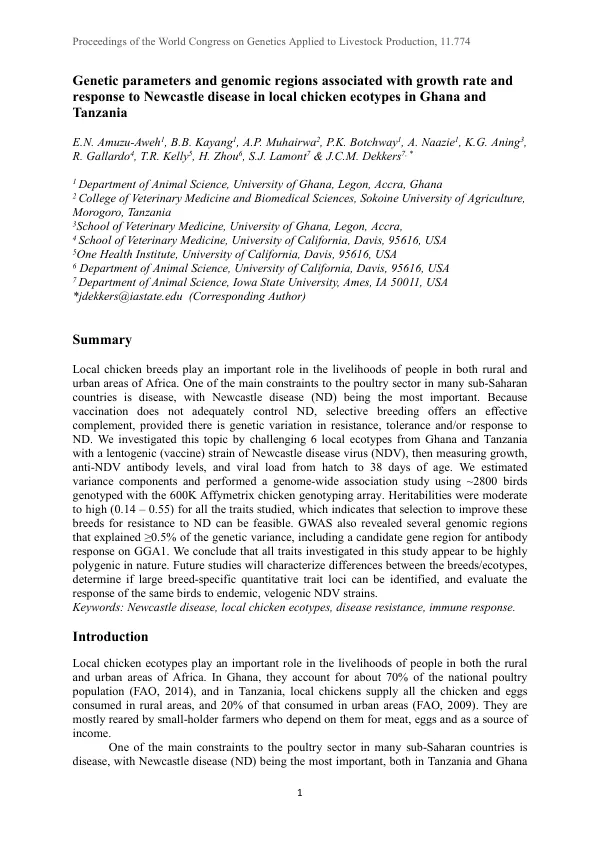
In Ghana, they account for about 70% of the national poultry population, while in Tanzania, local chickens supply all the chicken and eggs consumed in rural areas and 20% of that consumed in urban areas. One of the main constraints to the poultry sector in many sub-Saharan countries is disease, with Newcastle disease (ND) being the most important. Vaccination is not an adequate means of controlling ND in rural Africa due to cost, lack of a "cool chain," poor husbandry practices, instability of vaccines, and difficulty in correctly administering vaccines. Selective breeding offers an effective complement to vaccination, provided there is genetic variation in resistance, tolerance, and/or response to ND. To investigate this topic, researchers challenged six local ecotypes from Ghana and Tanzania with a lentogenic (vaccine) strain of Newcastle disease virus (NDV). The traits studied included pre- and post-infection growth rate, log-transformed viral load at 2 and 6 days post-infection (dpi), and log-transformed anti-NDV antibody titers at 10 dpi. The study aimed to estimate genetic parameters and identify genomic regions associated with productivity and response to NDV challenge. The experimental design involved creating experimental flocks from local farmers across the country. Adult birds of six ecotypes (three per country) were sourced and served as the breeding stocks for the experimental populations. Fertile eggs were collected, incubated, and hatched, and the chicks were transferred to a separate, bio-secure facility where the NDV challenge was performed. The challenge experiment ran from hatch to 38 days of age, with all birds raised under the same conditions. Blood samples were collected at 27 days of age to quantify maternal antibody levels, and at 28 days of age, birds were challenged with 10^7 EID50 of LaSota lentogenic NDV strain. Genetic parameters were estimated using animal models implemented in ASReml4, and heritabilities for all traits were moderate to high, indicating a good potential for improving these traits with selective breeding. For the Ghanaian population, viral load at 2 dpi had a higher heritability than that at 6 dpi. Heritabilities were generally higher for Ghana than for Tanzania, and all heritabilities were higher for these local ecotypes than in US-based commercial layer lines that underwent a similar experiment. A genome-wide association study (GWAS) was performed to identify genomic regions associated with the traits studied. The GWAS revealed several genomic regions associated with the traits, including a candidate gene region for antibody response on GGA1. For Ghana, there were 13 regions on 10 chromosomes that together explained 13.3% of the total genetic variance (TGV) for pre-infection growth rate, 4 regions on 4 chromosomes explaining 4% of TGV for post-infection growth rate, 7 regions on 6 chromosomes explaining 8.3% of TGV for antibody titer at 10 dpi, and 9 regions on 6 chromosomes explaining 11.2% of TGV for viral load at 2 dpi. The results suggest that all traits investigated in this study appear to be highly polygenic in nature. Future studies will characterize differences between the breeds/ecotypes, determine if large breed-specific quantitative trait loci can be identified, and evaluate the response of the same birds to endemic, velogenic NDV strains. The study provides valuable information for breeding robust local breeds enhancing genetic resistance to ND and subsequently improving the local poultry production system.
Related documents