USAID DEC
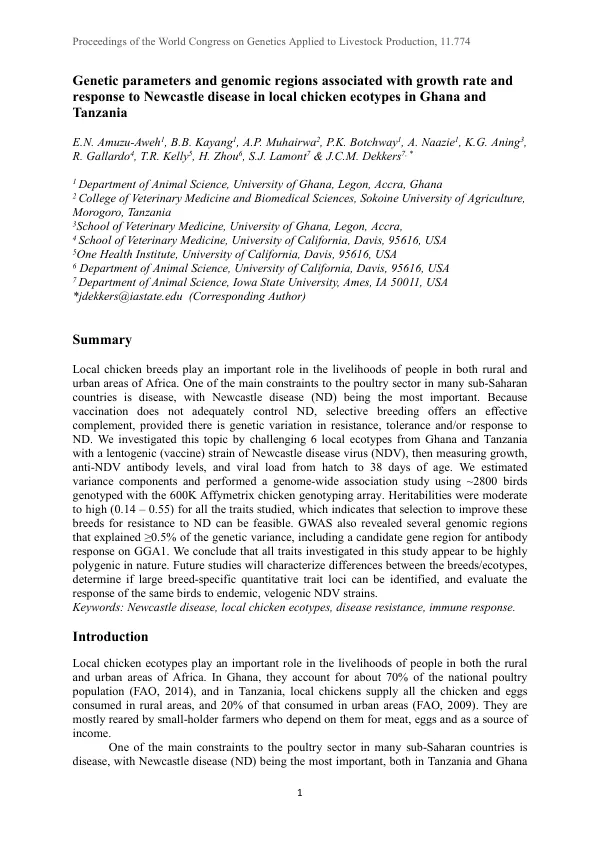
Second Annual Report for Feed the Future Innovation Lab for Genomics to Improve Poultry
Sign inHUAZHONG AGRICULTURAL UNIVERSITY
Second Annual Report for Feed the Future Innovation Lab for Genomics to Improve Poultry
The Feed the Future Innovation Lab for Genomics to Improve Poultry is a research program aimed at enhancing the production of chicken by households and small farmers in Africa.
2015 · 18 pages
Sign in to readA free account is required to download.
Abstract
The program seeks to improve food security, nutrition, and livelihoods in Africa by applying advanced genetics and genomics to sustainably enhance innate resistance to Newcastle disease (ND) and heat stress in chickens adapted to the African environment. Newcastle disease is the number one constraint of raising poultry in Africa, causing mortality as high as 80% among village chicken flocks in most rural communities. The research program is focused on identifying chicken genes or genetic markers associated with NDV resistance and breeding innately disease-resistant chicken strains for the use of household producers and small farmers. The program is led by the University of California, Davis (UC Davis), with partners from Iowa State University (ISU), University of Ghana (UOG), Sokoine University of Agriculture (SUA), and University of Delaware (UOD). The research program is structured around several objectives, including identifying chicken genes or genetic markers associated with NDV resistance, breeding innately disease-resistant chicken strains, and developing biosecurity protocols for program activities. During the second year of the program, good progress was made toward implementing Objectives 1 and 2. Challenge trials, including inbred lines and Hy-Line Brown, were completed at UC Davis and ISU. Pilot studies were completed at SUA and UOG, and formal trials were initiated. The research program will proceed as planned in year 3, with the main challenges being power outages and biosecurity. The program has made significant accomplishments, including completing challenge trials, analyzing virus titers and antibody response, measuring body temperature and blood physiological responses to heat stress, and identifying genes and signal pathways associated with NDV resistance and heat tolerance. Training was provided to African partners on sampling procedures, laboratory assays, and biosecurity protocols. The program has also established research breeding flocks at UOG and SUA, developed and implemented biosecurity protocols, and completed pilot challenge experiments. Staff were trained in the US, UOG, and SUA on sampling procedures and laboratory assays. A one-day workshop was conducted in Morogoro, Tanzania, to solicit expertise from experts on poultry breeding and distribution. The program's geographic focus is on Africa, with a specific emphasis on Ghana, Tanzania, and other countries in the region. The program's timeframes are from October 2014 to September 2015, with plans to proceed as scheduled in year 3. The program's recommendations include strengthening biosecurity procedures, installing backup power systems, and providing ongoing training to African partners. The program's research program overview and structure include several key components, including the identification of chicken genes or genetic markers associated with NDV resistance, breeding innately disease-resistant chicken strains, and developing biosecurity protocols for program activities. The program's research methodology includes challenge trials, RNA-seq analysis, and genotyping of birds using the chicken 600K SNP panel. The program's human and institutional capacity development component includes short-term and long-term training for African partners, as well as institutional development and capacity building. The program's environmental management and mitigation plan (EMMP) includes measures to minimize the impact of the program on the environment and to mitigate any potential risks. The program's open data management plan includes the sharing of data and results with the research community and stakeholders. The program's project management activity includes regular conference calls among the management team, as well as weekly calls with SUA and UOG. The program's future directions include continuing to implement Objectives 1 and 2, as well as initiating Objective 6, which focuses on assessing models for breeding and distribution of improved chicken breeds for the program.
Related documents