USAID DEC
Genotypic Regulation of Aflatoxin Accumulation but Not Aspergillus Fungal Growth upon Post-Harvest Infection of Peanut (Arachis hypogaea L.) Seeds
Sign inTHE INTERNATIONAL CROPS RESEARCH INSTITUTE FOR THE SEMI-ARID TROPICS
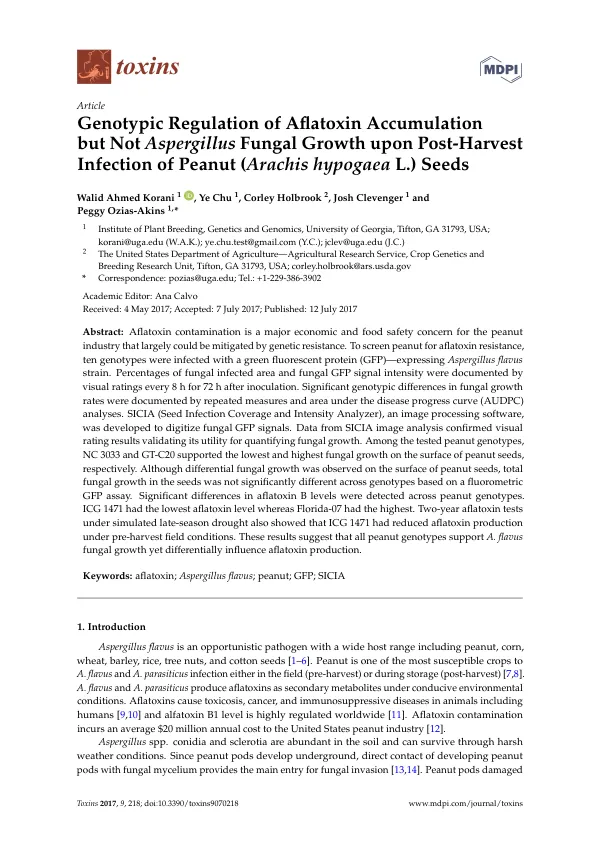
Genotypic Regulation of Aflatoxin Accumulation but Not Aspergillus Fungal Growth upon Post-Harvest Infection of Peanut (Arachis hypogaea L.) Seeds
Aflatoxin contamination is a major economic and food safety concern for the peanut industry.
2017 · 12 pages
Sign in to readA free account is required to download.
Abstract
The pathogen Aspergillus flavus is responsible for producing aflatotoxins, which can cause toxicosis, cancer, and immunosuppressive diseases in animals and humans. Aflatoxin contamination incurs an average $20 million annual cost to the United States peanut industry. Aspergillus spp. conidia and sclerotia are abundant in the soil and can survive through harsh weather conditions. Peanut pods develop underground, providing a direct entry point for fungal invasion. Insect and nematode damage to peanut pods can also lead to elevated levels of aflatoxin contamination. Heat and drought stress in the field exacerbate aflatoxin contamination. Development of aflatoxin-resistant peanut cultivars has been a challenging goal due to the large variation in pre-harvest aflatoxin contamination. Even aflatoxin-resistant lines accumulated widely different levels of aflatoxin when grown in the same or different environments. To circumvent this issue, in vitro inoculation has been used to ensure more uniform fungal infection of seeds. In this study, ten peanut genotypes were selected based on their previously reported resistance to aflatoxin contamination and drought tolerance. The genotypes were inoculated with a green fluorescent protein (GFP)-expressing Aspergillus flavus strain and evaluated for fungal growth and aflatoxin contamination over a 3-d time course. Genotypic differences in aflatoxin production per unit of fungus were documented. Significant genotypic differences in fungal growth rates were documented by repeated measures and area under the disease progress curve (AUDPC) analyses. The SICIA (Seed Infection Coverage and Intensity Analyzer) image processing software was developed to digitize fungal GFP signals, confirming visual rating results and validating its utility for quantifying fungal growth. Among the tested peanut genotypes, NC 3033 and GT-C20 supported the lowest and highest fungal growth on the surface of peanut seeds, respectively. Although differential fungal growth was observed on the surface of peanut seeds, total fungal growth in the seeds was not significantly different across genotypes based on a fluorometric GFP assay. Significant differences in aflatoxin B levels were detected across peanut genotypes, with ICG 1471 having the lowest aflatoxin level and Florida-07 having the highest. Two-year aflatoxin tests under simulated late-season drought also showed that ICG 1471 had reduced aflatoxin production under pre-harvest field conditions. The results suggest that all peanut genotypes support A. flavus fungal growth yet differentially influence aflatoxin production. The study provides new insights into the genetic regulation of aflatoxin accumulation and fungal growth in peanut seeds, which can inform the development of aflatoxin-resistant peanut cultivars.
Related documents
Documents in this collection
 2017
2017USAID DEC
Extinct, obscure or imaginary: The lizard species with the smallest ranges
Open record 2012
2012USAID DEC