USAID DEC
Multi-Toxic Endpoints of the Foodborne Mycotoxins in Nematode Caenorhabditis elegans
Sign inLINCOLN UNIVERSITY
Multi-Toxic Endpoints of the Foodborne Mycotoxins in Nematode Caenorhabditis elegans
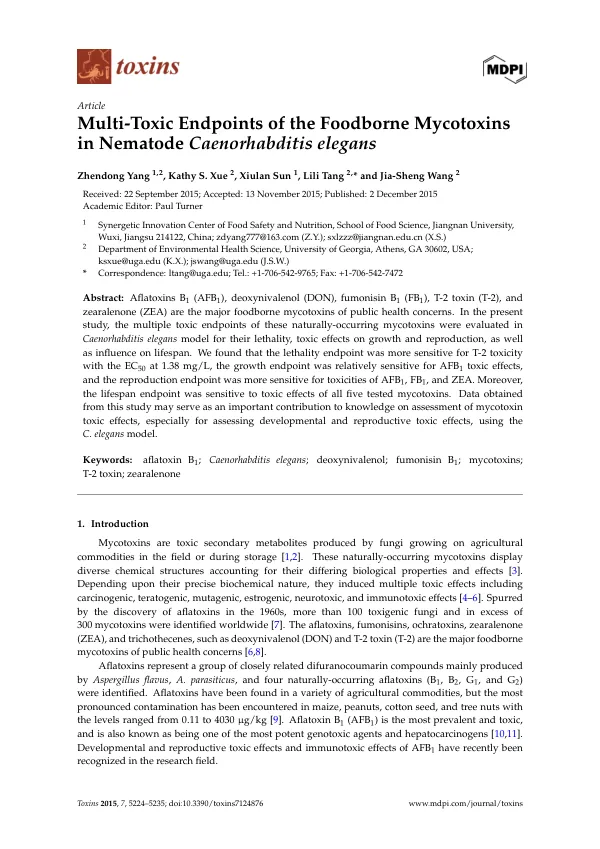
Aflatoxins B1 (AFB1), deoxynivalenol (DON), fumonisin B1 (FB1), T-2 toxin (T-2), and zearalenone (ZEA) are major foodborne mycotoxins of public health concern.
2015 · 12 pages
Sign in to readA free account is required to download.
Abstract
These naturally-occurring mycotoxins display diverse chemical structures, accounting for their differing biological properties and effects. They induce multiple toxic effects, including carcinogenic, teratogenic, mutagenic, estrogenic, neurotoxic, and immunotoxic effects. Aflatoxins are a group of closely related difuranocoumarin compounds mainly produced by Aspergillus flavus, A. parasiticus, and four naturally-occurring aflatoxins (B1, B2, G1, and G2) were identified. Aflatoxin B1 (AFB1) is the most prevalent and toxic, and is also known as being one of the most potent genotoxic agents and hepatocarcinogens. Developmental and reproductive toxic effects and immunotoxic effects of AFB1 have recently been recognized in the research field. Fumonisins are primarily produced by the fungi Fusarium verticillioides. The most common fumonisin found in maize is fumonisin B1 (FB1), while fumonisins B2 and B3 (FB2 and FB3) are common co-contaminants. FB1 exposure was suggested to link to a broad spectrum of animal and human diseases, such as hepatocellular carcinoma and esophageal cancer in South Africa, China, and the Islamic Republic of Iran. Zearalenone (ZEA) is mainly produced by Fusarium graminearum and is primarily contaminated maize but occurs in modest concentrations in wheat, barley, and sorghum. ZEA induces genotoxicity, immunotoxicity, developmental and reproductive toxicities, and tumorigenicity in various animal models. Due to its structural similarity to estrogen, ZEA may bind to human estrogen receptors and elicit permanent reproductive tract alterations. Deoxynivalenol (DON) and T-2 are trichothecene mycotoxins produced by many fungi genera and plants. DON is probably the most widely distributed Fusarium mycotoxin in cereals, and its contamination was reported in various crops and processed grains. T-2 has been reported in cereals in many parts of the world and is formed in large quantities under the unusual circumstance of prolonged wet weather at harvest. The nematode Caenorhabditis elegans (C. elegans) is a popular model organism for genetic and developmental biology research and is now being recognized as an attractive invertebrate model for toxicological studies. C. elegans has some attractive properties, such as a short life cycle (3-4 days), ease of culturing, and low cost. Its well-defined genome, completed cell lineage map, knockout (KO) mutant libraries, and well-established methodologies can provide a variety of options to manipulate molecular mechanisms. In this study, the multiple toxic endpoints of common foodborne mycotoxins, AFB1, DON, FB1, T-2, and ZEA, were investigated in C. elegans model, including lethality, toxic effects on growth and reproduction as well as influence on lifespan. The potency for lethality, as represented by LC50 values, in the wild-type N2 worms was T-2 > AFB1 > ZEA > FB1 > DON. The toxicity ranking based on LC50 is T-2 (1 mg) > AFB1 (20 mg) > ZEA (76 mg) > FB1 (235 mg) > DON (657 mg).