USAID DEC
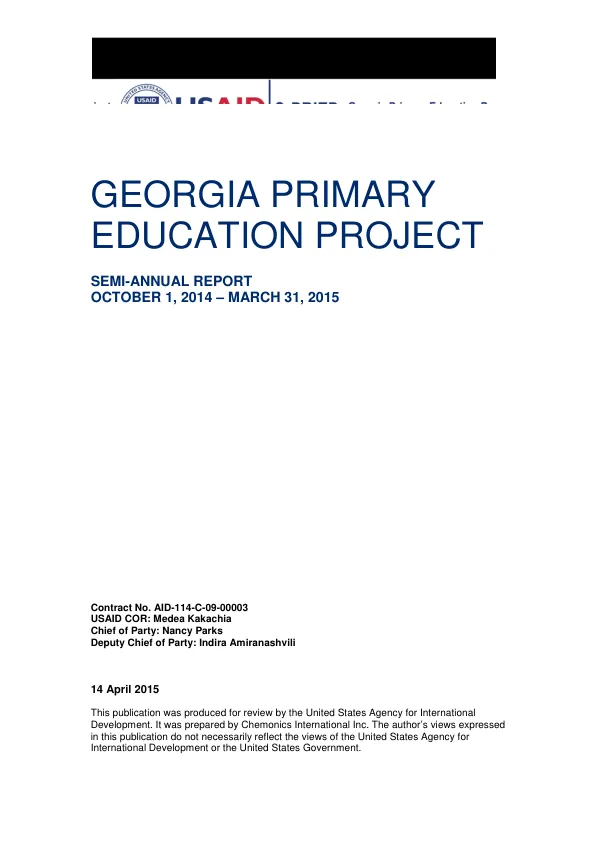
Georgia Primary Education Project Semi-Annual Report October 1, 2014 – March 31, 2015
Sign inCHEMONICS
Georgia Primary Education Project Semi-Annual Report October 1, 2014 – March 31, 2015
The Georgia Primary Education Project aims to improve reading and math competencies of Georgian and ethnic minority students in grades 1-6.
2015 · 77 pages
Sign in to readA free account is required to download.
Abstract
The project is a five-year initiative that began in 2011 and is expected to conclude in September 2016. The project is implemented by Chemonics International, with funding from the United States Agency for International Development (USAID). The project's primary objectives include improving reading and math instruction for approximately 40,000 students in approximately 300 schools, enhancing community and public engagement, accountability, and transparency in the same schools, and improving reading and math delivery systems in Georgia's primary education system. The project also aims to improve the business skills of at least 8,000 Grade 1-6 students in a minimum of 35 pilot schools with the support of at least 80 private sector volunteers. During the reporting period from October 1, 2014 to March 31, 2015, the project achieved several significant milestones. Funding was awarded for the fourth component, "Improving Business Skills," and training for 1,264 reading and math teachers in grades 1-6 in Georgian and non-Georgian pilot schools was completed in February 2015 with an overall 97% attendance rate. Additionally, 93 national reading and math trainers attended training sessions to prepare for teacher training delivery, and 42 reading trainers and 51 math trainers received training to prepare for teacher trainings. The project also made progress in implementing Teacher Learning Circles (TLC) meetings, with 178 TLC facilitators conducting 1,137 TLC meetings between September and December 2014. Furthermore, 22 TLC facilitators from ethnic minority communities received training to support the project's goals. The project works closely with the Ministry of Education and Science to support instructional improvements, improve standards, increase the use of instructional materials and formative assessments, build the capacity of Georgian teachers to deliver new math and reading instructional approaches, and increase parental and community engagement in schools. The project's progress is reviewed against the Year IV work plan components, and the report highlights the achievements and challenges faced during the reporting period. The project's success relies on the support of various stakeholders, including the Contracting Officer's Representative (COR), Dr. Medea Kakachia, and representatives from the Ministry of Education and Science, the National Center for Educational Quality Enhancement, the National Examinations Center, the Teacher Professional Development Center, and the Department for International Relations and Programs.