FUTURES GROUP INTERNATIONAL, LLC
Getting to “Stigma-Free” Services in Antigua and Barbuda: Survey Results
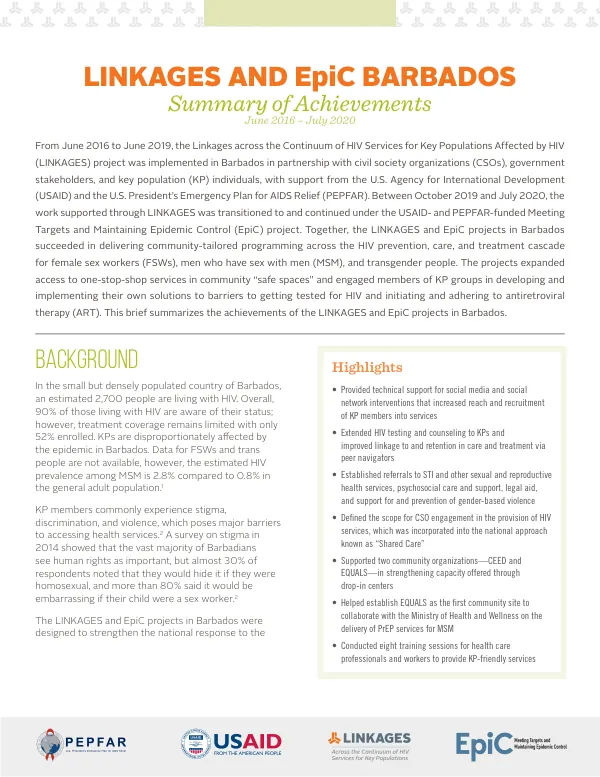
HIV-related stigma and discrimination (S&D) are widely recognized in the Caribbean region and globally as critical barriers to HIV prevention, care, and treatment, particularly for key populations who often experience additional stigmas beyond HIV.
2015 · 44 pages
Sign in to readA free account is required to download.
Abstract
S&D violate human rights and keep people from seeking HIV testing, disclosing their HIV status, practicing preventive behaviors, accessing care, and adhering to treatment. The Pan Caribbean Partnership Against HIV and AIDS (PANCAP), with support from the USAID- and PEPFAR-funded Health Policy Project (HPP) and other regional partners, developed the PANCAP Stigma Reduction Framework for HIV and AIDS: National Actions to Reduce HIV-Related Stigma & Discrimination and Improve Health Outcomes (2012), which provides guidance on developing national strategies for action to address S&D. This framework recognizes the importance of S&D reduction to an effective and efficient response to HIV. In Antigua and Barbuda, the National AIDS Programme of the Ministry of Health (MOH) collaborated with HPP, the University of the West Indies (UWI), and other partners in developing and testing a comprehensive S&D-reduction programme in health facilities. The programme aims to strengthen individual and health system capacities to ensure stigma-free health services and measures stigma to inform programme design, health facility and national-level policy, ongoing learning, and evaluation. A baseline survey was conducted in Antigua and Barbuda to assess the level of S&D among health facility staff. The survey involved interviews with a representative sample of health and auxiliary staff in all levels of health facilities. Survey questions addressed critical programming areas such as fear of HIV transmission through work-based exposure to people living with HIV (PLHIV), opinions about PLHIV (especially pregnant women living with HIV), and the health facility environment. Survey data also measured levels of S&D, willingness to provide treatment to stigmatised populations, secondary stigma, and possible S&D towards health facility staff living with HIV. The survey found that a total of 430 respondents, including administrative support staff, medical personnel, cleaning/auxiliary staff, pharmacists, and related technicians, formed the basis of this report. Frequencies for key results areas of all questions asked, including training, infection concerns, health facility environment, health facility policies, opinions about PLHIV and key populations, and caring for pregnant women living with HIV, are presented in these broad job categories. The programme includes two key elements: 1) strengthening the capacity of health facilities and health facility staff to provide S&D-free services, and 2) collecting data to inform programme design, health facility and national-level policy, and ongoing learning, and to support evaluation. This report focuses on the initial stage of this second element: collection of baseline data from the health delivery system in Antigua and Barbuda. These data provide a foundation on which to design evidence-informed S&D-reduction programming and evaluate change over time. The USAID- and PEPFAR-funded Health Policy Project's support for this work is part of an overall strategy to support S&D-reduction activities globally. The strategy includes 1) measuring stigma and discrimination in healthcare facilities; 2) training health personnel on stigma and discrimination and having them develop facility policies for S&D reduction; and 3) working with key populations to enhance stigma reduction and stigma monitoring skills. The report identifies key areas for action in the health system in order to reduce stigma. These areas include addressing fear of HIV transmission through work-based exposure to PLHIV, improving opinions about PLHIV and key populations, and enhancing the health facility environment to promote stigma-free services.
Related documents