USAID. MISSION TO GHANA
Ghana primary education program
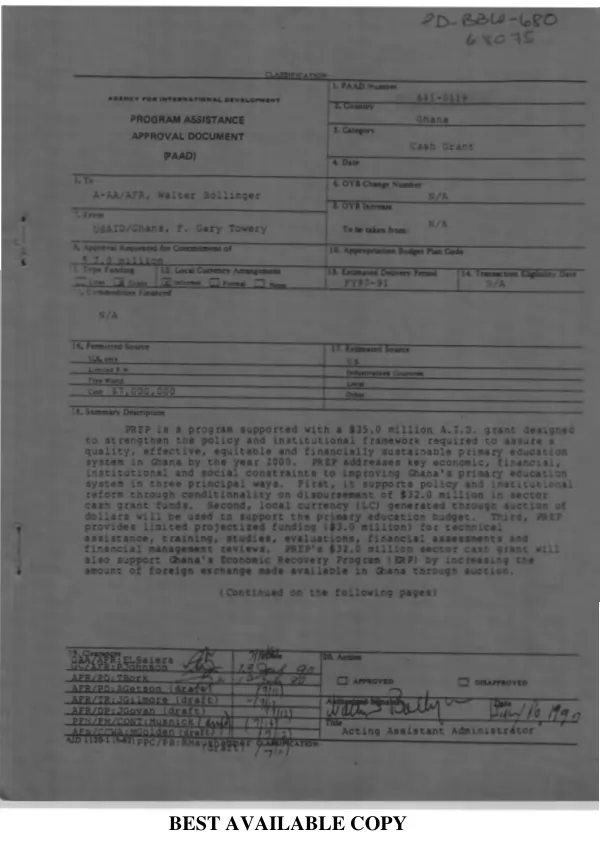
Sector grant to strengthen the policy and institutional framework of Ghana"s primary education system.
1990
Sign in to readA free account is required to download.
Abstract
The program consists of a cash grant of $32 million, complemented by TA under 6410120. Conditionality focuses on: primary education budgeting; Ministry of Education (MOE) decentralization; teacher training; equity improvement; and student testing. Local currency generated by the auction of U.S. dollars will support the primary education budget. To ensure adequate funding, the program will require the MOE to disaggregate data on primary education budgets and expenditures, maintain the overall budget share for primary education at no less than 1989 levels, and increase its budget allocation for primary education materials to a least 6%. Decentralization of the MOE will be a major requirement of the program. A committee formed by the Provisional National Defense Council has recommended several measures to transfer responsibilities, especially managerial and financial, from the MOE to the nation"s 110 District Education Offices. Although details have not been finalized, the program will support an approved MOE decentralization policy and implementation plan. The program will require the MOE to implement an A.I.D.-approved staff development plan to provide approximately 200,000 teacher- weeks of in-service training for primary school teachers and MOE staff over the next 5 years. The MOE will also be required to present evidence that 90% of primary school teachers have been trained to minimum standards by the end of the program. To improve access to education, the Government of Ghana will be required to undertake an Equity Improvement Program (EIP) and equity improvement policy designed to reduce enrollment discrepancies between geographical areas, income levels, and sexes. There will be a 50% overall increase in overall enrollment and a 25% increase in retention of all children, including girls, in areas targeted by the EIP. Finally, the program will require student achievement tests as a measure of the overall quality of the educational system. After consideration, criterion-referenced testing (CRT) was deemed the most appropriate testing method for Ghanaian students. CRT"s reading, writing, and arithmetic will be developed for primary school students and administered at the 6th grade level. Approximately 63,000 primary school educators, 1,400 supervisory personnel, and 2.1 million children are expected to benefit from the program.