DEPARTMENT OF HEALTH AND HUMAN SERVICES
GHI Principles: Health System Strengthening
Health Systems Strengthening is a critical component in achieving progress in global health.
2012 · 1 pages
Sign in to readA free account is required to download.
Abstract
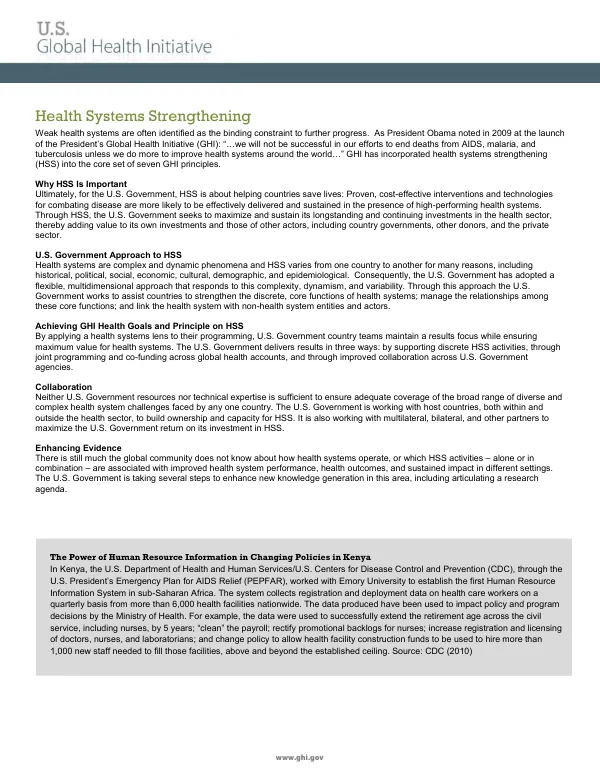
The President's Global Health Initiative (GHI) has incorporated Health Systems Strengthening (HSS) into its core principles, with the goal of improving health systems around the world. This approach is essential for delivering and sustaining proven, cost-effective interventions and technologies for combating diseases such as malaria, tuberculosis, and tuberculosis. The U.S. Government's approach to HSS is flexible and multidimensional, responding to the complex and dynamic nature of health systems. This approach involves assisting countries in strengthening the core functions of health systems, managing relationships among these functions, and integrating the health system with non-health system entities and actors. By applying a health systems lens to their programming, U.S. Government country teams maintain a results focus while ensuring value for health systems. The U.S. Government delivers results in three ways: by supporting discrete HSS activities, joint programming and co-funding across global health accounts, and improved collaboration across U.S. Government agencies. Collaboration is essential in addressing the diverse and complex health system challenges faced by countries, and the U.S. Government is working with host countries, multilateral, bilateral, and other partners to build ownership and capacity for HSS. This collaboration aims to maximize the U.S. Government's return on investment in HSS. Research and knowledge generation are critical components in enhancing the effectiveness of HSS. The U.S. Government is taking several steps to articulate a research agenda and generate new knowledge in this area. This research aims to identify the most effective HSS activities and combinations of activities that lead to improved health system performance, health outcomes, and impact in different settings. In Kenya, the U.S. Department of Health and Human Services and the U.S. Centers for Disease Control and Prevention (CDC) have established a Human Resource Information System to collect data on health care worker registration and deployment. This system has produced data that have impacted policy and program decisions by the Ministry of Health, including extending the retirement age for nurses, "cleaning the payroll," and increasing registration and licensing for doctors, nurses, and other health professionals.