USAID DEC
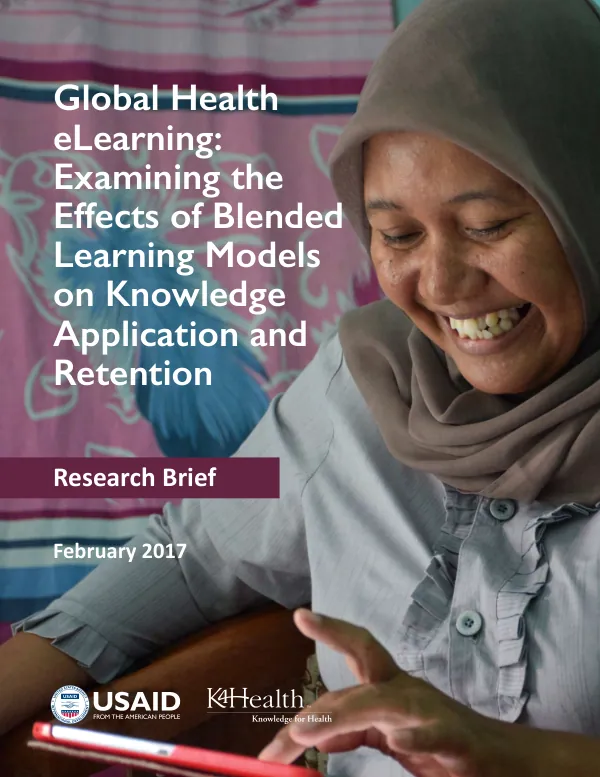
Global Health eLearning: Examining the Effects of Blended Learning Models on Knowledge Application and Retention
Sign inFHI 360
Global Health eLearning: Examining the Effects of Blended Learning Models on Knowledge Application and Retention
The Knowledge for Health (K4Health) project conducted a cross-sectional study to examine the effects of blended learning models on knowledge application and retention among health professionals in lower- and middle-income countries.
2017 · 6 pages
Sign in to readA free account is required to download.
Abstract
The study focused on the "U.S. Abortion and Family Planning Requirements" compliance course, which is a critical component of family planning programs. The study found that blended learning models, which combine traditional learning settings with online learning approaches, are effective in strengthening learning outcomes and application of knowledge. The study identified five exposure groups: respondents who took the eLearning course once, respondents who took the eLearning course multiple times, respondents who took the eLearning course and participated in the in-person training, respondents who took the eLearning course and participated in the conference call, and respondents who took the eLearning course, participated in the in-person training, and participated in the conference call. The results showed that respondents who participated in all three learning approaches had greater knowledge retention and application compared with respondents who completed only one or two of the learning modes. Specifically, the group that took the online course, participated in the in-person training, and participated in the conference call (Group E) scored highest in terms of knowledge retention, with a mean score of 8.68 (1.64). This group also had the highest proportion of respondents indicating that they had applied the knowledge they gained, with 95% of respondents reporting application. The study's findings have broader implications for long-distance learning for health professionals in general. While eLearning courses are effective teaching platforms for reaching health professionals in lower- and middle-income countries, blended learning models have the potential to reinforce learning and application of knowledge, which is crucial to ensuring health professionals around the world have access to accurate and timely health information. The study's results suggest that blended learning models can be an effective strategy for promoting knowledge application and retention among health professionals in lower- and middle-income countries. The study's findings can inform the development of blended learning models for family planning and other health-related topics, and can contribute to the improvement of health outcomes in these countries. The study's methodology involved collecting data through online surveys from respondents who had completed the "U.S. Abortion and Family Planning Requirements" eLearning course between July 2013 and April 2015. The study used purposive sampling to select respondents, and the survey data were analyzed using SPSS version 23 and Stata version 14. The study's results are consistent with previous research on the effectiveness of blended learning models in promoting knowledge retention and application. The study's findings suggest that blended learning models can be an effective strategy for promoting knowledge application and retention among health professionals in lower- and middle-income countries, and can contribute to the improvement of health outcomes in these countries.