INTERNATIONAL FOOD POLICY RESEARCH INSTITUTE (IFPRI)
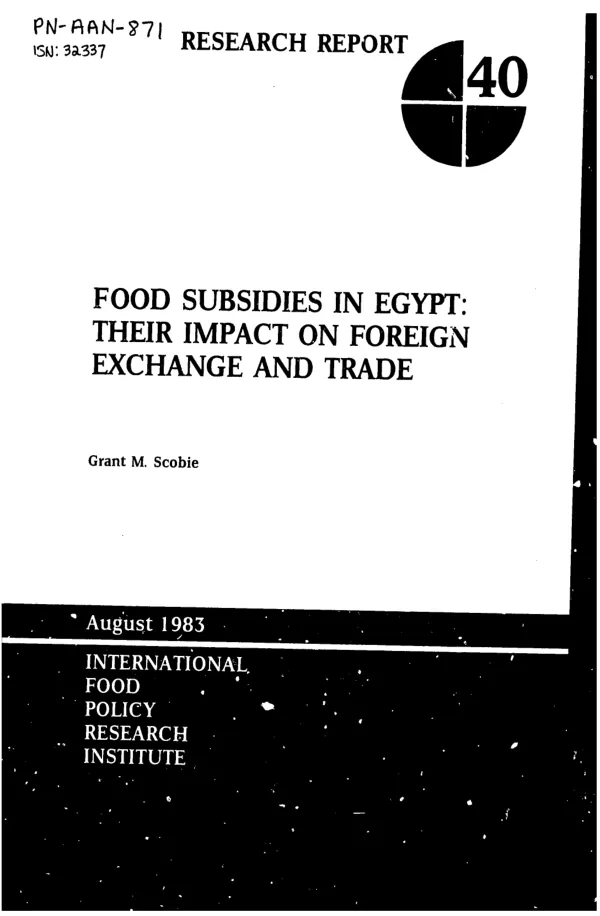
Government policy and food imports : the case of wheat in Egypt
The determination of many national and international food policies requires knowledge about the responses of imports to varying circumstances.
Scobie, Grant M. · 1981
Sign in to readA free account is required to download.
Abstract
This report describes an econometric model, based on conditions observed in Egypt, of the determinants of food imports in developing countries. First, the author explores trends in global wheat trade and traces Egyptian wheat policy since 1800, emphasizing the post-war era. Using data for the period 1949-79, the author develops an econometric model, recognizing that decisions about the level of wheat imports are part of a balance of payments mechanism; that wheat imports reflect domestic pricing policies; and that cotton is important as a competitor for productive resources and as a source of foreign exchange. Mathematical equations are generated to model the balance of payments adjustment block, the wheat import block, and the cotton import block. The study shows that Egypt"s capacity to import - a function of both wheat and cotton pricing policies - is a principal determinant of domestic wheat policies and influences both the level and composition of imports. Since wheat imports are highly unresponsive to changes in foreign exchange earnings, any compensatory financing will have little effect on wheat imports and will likely be used to stabilize the level of nonfood imports. A rise in the world price of wheat leads to higher wheat prices for both producers and consumers, dampening demand and stimulating production. Simultaneously, shipments of aid wheat fall and expenditures for imported wheat rise. Thus, despite a modest rise in domestic output, much of the adjustment is taken up by reduced consumption and cuts in other imports. Given these price interactions, it can be inferred that if Egypt would reduce pricing protection and restrict subsidies, both demand for and importation of wheat would fall, food imports would be less of a destabilizing force, and economic activity in the non-farm sector would be stimulated. The report includes 21 tables and nine diagrams. Appended are a list of 146 references (1938-81) and reports on the private and social demand for wheat, import demand models incorporating government policy measures, and the bias inherent in determining import response to changes in the national balance-of-payments.